Key takeaways:
• Why it's OK that some friendships fade
• Friends help us cope with stress
• Quality friends, over quantity
• Mom groups and other ways to find new friends
• 4 Ways to be a good friend to other moms
“I really like her,” I told my husband one recent evening, having just returned from a park playdate with my youngest son’s new preschool pal. “I think it’s a new friend!” No, I wasn’t talking about the other 4-year-old in the equation, but rather his mom. She was laid-back, the banter was easy, and we both were running about 10 minutes late. If this was Mom Tinder, I’d swipe right. Indeed, sometimes making mom friends feels a little like dating. It can be awkward, nerve-wracking and at times downright exhausting. We’re already being pulled in so many directions, who even has time for friends?
Between the demands of parenting and the shift in identity that comes with motherhood, it’s not uncommon for your social life to fall by the wayside. After all, parenthood changes every aspect of your life, relationships included. And maintaining friendships—or fostering new ones—takes time and intention.
But friendships can be worth effort—and the awkwardness. Many moms report feeling isolated in motherhood, and strong social connections can be the antidote to this loneliness. And while parenting may dim some relationships, it can also bring us closer to friends as we live shared experiences raising kids.
RELATED: Mom Groups in Dallas-Fort Worth
It’s OK That Some Friendships Fade
While busy raising four kids, Emily Lambert, who lives north of Dallas, says her friendships have changed drastically—if they exist at all. “I don’t know how I’ll ever have time to do anything else [than take care of the kids], so for right now, my social life is on hold,” she says.
The truth is, it’s not uncommon for friendships to fade after having kids. On top of the day-to-day changes that come with being someone’s parent—new routines, sleep schedules, school projects, household responsibilities—there’s also an identity shift that comes with parenthood. So even if you can find the time to keep in touch with an old friend, the connection might not be the same.
“If mothers maintain or grow friendships—in the perinatal period or when they become moms—it improves their mental health, it decreases anxiety and it builds their self-confidence.”
“You go through this identity change and then there’s a change in how that impacts all your relationships,” explains Dr. Margaret Vadiee, a licensed psychologist at Behavioral Health Dallas who’s certified in maternal mental health. “It is hard, but you’re not alone in that. It’s kind of normal process of motherhood that happens.”
And friendships change with all life transitions, not just with having kids. When you graduate college, get married or change careers—at all different milestones, your friendships will start to look a little different. “Sometimes friends are just for a season,” says Jennifer Eklund, a licensed professional counselor who owns Maternal Counseling Co. in Fort Worth and specializes in perinatal mental health. “It’s OK to let some friendships fall to the wayside. Maybe there’s some sadness in that but it’s also OK.”
RELATED: How to Stay Friends With the Child-Free
Friends Help Us Cope With Stress
While it’s not weird or wrong to find yourself without much of a social life, putting in the time to maintain important connections or find new ones is worth the effort. People with strong friendships have a lower risk for many health problems including depression and high blood pressure, and studies have even found that adults with close social connections are likely to live longer than those who don’t. And female friendships, in particular, have been shown to help women cope with stress more effectively.
There’s even further tangible benefits for moms. “There’s research that says if mothers maintain or grow friendships—in the perinatal period or when they become moms—it improves their mental health, it decreases anxiety and it builds their self-confidence,” says Vadiee. Plus, strong social support, including friendships, can help mitigate the risk and severity of postpartum depression.
So yes, science confirms having friends is good for your health. And in turn, it’s good for your kids, too.
“One of the greatest indicators for children’s well-being and metal health in general is the quality of the mom’s happiness and how well the mom takes care of herself,” says Eklund. “And so if you’re constantly pouring out and never taking in, never filling your cup, you’re not going to be the greatest mom all the time.”
RELATED: How to Help a Friend Dealing with Postpartum Depression
Quality Friends, Over Quantity
When it comes to friendships after kids, keep in mind it’s quality over quantity. You don’t need a huge social network; a just a couple friends. And in this phase of life, you’ll likely find the best connection among other moms—women who get it when you need to cancel at the last minute because the kids are sick, or who can relate to taking a few days to text back because you’re busy doing all the things.
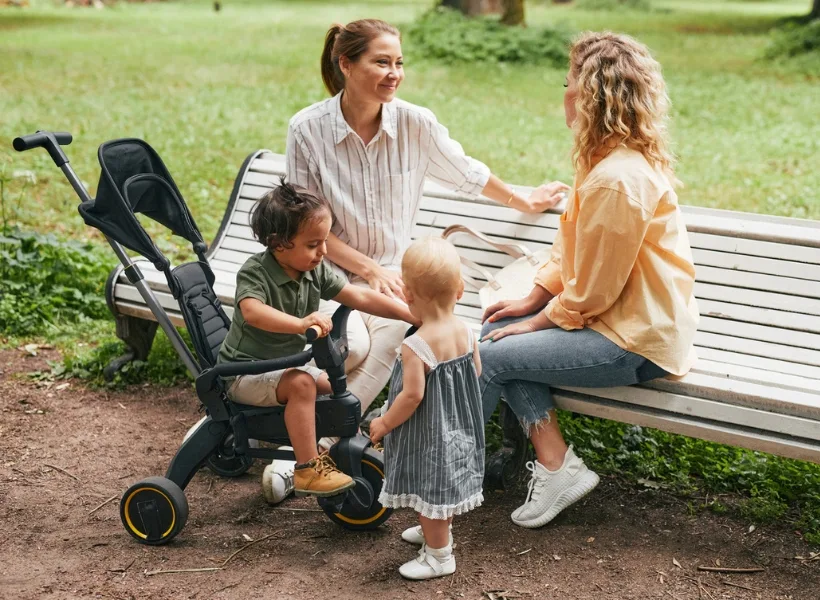
“You need people who will say, ‘Oh yeah, it’s normal that your kid is laying on the ground screaming because you peeled the banana wrong.’ You need people to normalize all these things for you, so you know they’re all going through that too; it isn’t just you, it isn’t just your kid,” says Vadiee. At the same time, these friends can help you assess if something maybe isn’t quite normal. “Your mom friends might say, ‘That hasn’t happened to us,’ or ‘We haven’t seen that,’ and it kind of gives you a little bit of a gut check.”
If you can find friends with kids around the same age as yours, even better. It’s easier to work these connections into your life because you’re already doing the same things. “You can say, ‘Hey, we’re going to the park at 10am, let’s meet up. And then you’ll be hanging out with someone who understands if you need to leave the conversation because your kid’s about to fall off the slide,” says Eklund.
How to Find Your Tribe
It can be hard to find new friends as an adult. For Haley Ballenger, a mom of two, finding a social circle felt especially intimidating when she relocated from Houston to Fort Worth in 2017.
“I found myself in a new town, with a new job, two young kids and almost zero time to socialize,” she says. “[My husband] is originally from here, so the only people we knew were ‘his’ people. They’re all lovely, especially my in-laws, but they’re not ‘my’ people.”
“Put yourself in situations where you’re going to be around other moms so you’ll have the opportunity to even meet them.”
Ballenger knew she couldn’t commit to any organizations that required a lot of in-person face time, and trying to find the “right” group to join online was looking for a needle in a haystack. “So, I decided to make my own,” she says of the Fort Worth Weird Moms Club, a Facebook group that’s grown to almost 2,500 members, many of whom she now counts as “real” friends she’s connected to off social media.
To find your people, you might have to take a leap like Ballenger. And while it might feel a little daunting to make the first move, remember, most moms want to meet and befriend other moms too.
“Put yourself in situations where you’re going to be around other moms so you’ll have the opportunity to even meet them,” says Vadiee. So go to that story time at the library, music class down the street or hang out at your kids’ soccer practice. “And then when you’re there, remember that everyone is looking for people. Introduce yourself, initiate conversation. If it feels right exchange numbers or ask to meet at the playground. Most people will be relieved that you’re the one that said it first because all moms are looking for friends and support and connection.”
And remember, in this busy season of life, strong friendships take some deliberation. “It has to be priority because it doesn’t just happen,” says Vadiee. “We don’t end up with a few free hours where you rest and rejuvenate and then you want to reach out to someone. It has to be something that you are intentional about.”
RELATED: Meet Allayya Wellness App Creator Jazmina Urriola
4 Ways to Be a Good Friend to Other Moms

1. Have an “OK cancellation” policy. “Be upfront and say, ‘You can cancel and reschedule with me at any time for whatever is going on with your family,’” says Vadiee. “I think that comes from a place of being really understanding; knowing that anything can come up. Give each other a lot of leeway.”
2. Check in without expectations. Your mom friend may not have time to sit and chat, so if you want to send a text to check in, keep it close-ended. “I’ll text a friend say, ‘Hey, I wanted to let you know I’m thinking of you. I’m doing all the mom things today but you’re on my mind and I hope you’re doing well, period.’ Then it doesn’t open the door to how are you? What’s been going on? Because they may not have that time,” says Eklund.
3. Hold your judgements. “Moms will be making other decisions about things than you, and what’s right for you doesn’t have to be what’s right for everyone else. Feeding, child care, school, whatever the hot topic is at that age,” Vadiee says. “So say, ‘That’s OK, you can make different decisions.’ Don’t let those things drive wedges between you.”
4. Don’t always talk about the kids. Do you ever feel like all of your conversations revolve around your kids? Your friend probably does, too. Take the time to really ask, ‘How are you doing?’ or ‘What are you reading?’ Try to connect outside of your roles as Mom.
RELATED: Why You Should Talk to a Therapist (Instead of Your Friends)
Images: iStock