One evening, Erin Urbanek walked by the room of one of her nine children. Twelve-year-old Jonathan was praying, listing all his siblings, for whom he was thankful.
“When he got down to Joel,” the mother remembers, “he said, ‘God bless Joel and thank you that he is in our family. I feel so bad that he has to have Down syndrome, but thank you for what it’s done to my heart.’”
No doubt Jonathan didn’t always feel so benevolent toward his little brother. Having a sibling with special needs is life changing. And not always worthy of a Norman Rockwell painting.
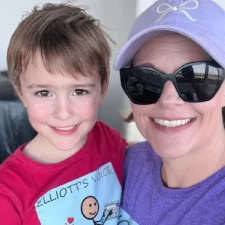
The Urbanek family of North Texas (pictured above) is made up of parents Erin and Rick and their five boys and four girls, ages 8 to 27.
“I don’t want to romanticize [our life with a child who has special needs], because it is definitely a lot of work,” she says. “The whole family has to take part in being aware of him and his needs. We have to be alert to make sure doors are locked. He’s always getting into something, but the joy kind of outweighs the hard work that’s involved.”
Do her kids agree? Yes, it is hard work, they say. And yes, it is worth it.
Joel’s siblings see the good and bad in having a brother with a special need. But as much as they love Joel, nobody likes his diapers.
Ben, who is 15, has this to say about his 8-year-old brother: “He’s made me a lot more accepting to people, less judgmental. But he’s still in diapers, and I have to babysit him a lot.”
Isabel, 13: “He’s happy all the time. Sometimes he throws fits and he makes big messes that we have to clean up.”
Joanie, 10: “He always plays with me and stuff like that, and whenever my sister is busy, he goes on the trampoline. But whenever he poos in his pants or something like that and Mom and Dad aren’t home, we have to help out with that.”
AJ and Rudy del Rosario of North Dallas work hard to make sure their typical daughter, Julia, 17, understands her importance in their family — a family comprising two younger siblings who have special needs (John Paul, 14, who has Asperger’s syndrome, ADHD and sensory issues, and Eleanor, 7, who has moderate to severe autism and mental retardation). The del Rosarios have two adult daughters with whom Julia sometimes travels for a break. AJ and Julia also have a mother-daughter weekly date to go out to eat or get their nails done, something “essential to both of us,” AJ says.
“The most difficult aspect for Julia, I imagine, would be that she has less time and less attention from me and her dad,” AJ says.
Julia agrees. But, like the Urbanek children, she sees the positives along with the struggles within her family.
Julia says her brother John Paul can “be a great person to talk to because sometimes things that ‘normal’ people make so complicated look so simple to him, and his simple advice is the best one I can get. He may seem like a geek or like a weird kid to some people, but I know what’s going on and it’s not really just him being weird.”
On her sister Eleanor: “Miss Ely … definitely has a mind of her own and has a flair for the dramatic. Dealing with Ely’s meltdowns isn’t always easy, so when I see a mom or a sibling [in public] who is trying to calm a kid down, I know there’s a chance the child may have special needs and can’t help the situation.”
Julia believes she is a different, more tolerant person because of her siblings. She volunteers at HEROES, a local summer camp for children with special needs, and says she would like to become a special education teacher.
The Urbaneks, like the del Rosarios, try to balance their family by paying attention.
“You can kind of tell which child is out of sorts,” Erin Urbanek says. “I might say, ‘Hey, maybe Dad can take Joel for a walk so you and I can get a bite to eat.’”
Both families have found healthy ways to care for their typical children, according to Dr. Carol Doss, a licensed family counselor in North Texas. Doss believes that, to the best of their ability, parents should try to give their typical child as, well, typical a childhood as possible. This means not overburdening them with responsibilities for their sibling and giving them one-on-one time with you.
“Their time has to be just as important and that child has to know they’re important,” Doss says. “The hardest part about this is these parents are already stressed. You’re dealing with a special-needs child of whatever variety, and it’s just sometimes a crushing job, trying to work, trying to be good parents. It’s already difficult, and I would never want to not acknowledge that with them.”
She continues, “At the same time, yes, [you’ve] got other kids. What’s really challenging is you’re asking a parent who is already overloaded to do more. But there’s really no other answer.”
Help, though, makes her advice easier to follow. So get it — for you and your typical kids — from support groups, grandparents, extended family, wherever you can, she says.
Debbie Clark, a social worker at the Children’s Medical Center of Dallas Down Syndrome and Genetics Clinic, offers psychosocial support for siblings. Clark says parents are often unsure how to explain a child’s special needs to a sibling.
“When I meet a new family, I am always concerned about the other children in the family,” Clark says. “I am interested in their adjustment to the birth of a new sibling, their understanding of [the child’s condition] and how each child’s needs will be met as the family faces this new challenge.”
Clark recommends age-appropriate honesty with typical children: “A 5-year-old needs different information than a 10-year-old. A teenager will need much more sophisticated information.”
Don Meyer, director of the Seattle-based Sibling Support Project and a national pioneer for services regarding fathers, siblings and grandparents of children with special needs, appreciates people like Clark and Doss who realize the importance of sibling care. He says he wishes there was more such emphasis in communities across the U.S. and beyond.
Meyer started working with fathers of children with special needs as a graduate student at the University of Washington in the late ’70s. He then co-founded a program for fathers and went on to establish Sibshops, lively programs structured especially for brothers and sisters of kids with special needs.
“We quickly saw there were other traditionally underserved family members of a child who had some sort of special need,” Meyer says. “So we developed one model for grandparents and also our SibShop model.”
Since 1990, his work primarily has been with siblings. His “elevator speech,” as he calls it, includes four points parents should keep in mind.
The first is that siblings with special needs have a similar experience as their parents.
“Just about anything you can say about being the part of a child with special needs you can pretty much put ditto marks underneath for brothers and sisters,” Meyer says. “They have many if not most of the same issues, as well as some that are uniquely their own.”
Two summers ago, Meyer trained Gretchen Purnell of Keller. She then established (with the help of a friend) the North Texas area’s first SibShop. Her 11-year-old son, Logan, has autism. Her daughter, Emily, is just 15 months older than Logan. Purnell says she realized that she had a network of support but Emily didn’t, which drove her to build a platform for sibling relationships in the Dallas-area special-needs community.
“We’ve had a network of parents and professionals that we interface with and get support from that our children don’t have,” Purnell says. “We really wanted to do this for our kids.”
Meyer explains that parents should take into account that siblings are likely to have the longest relationship with their child who has a special need.
“This relationship is easily in excess of 65 years — certainly longer than any service provider but probably longer than the parents as well. After the best special education program is a distant memory, and mom and dad are no longer there to look after the affairs, it will be the siblings who will ensure that person leads a dignified life. Sibling issues are lifespan issues,” he says.
Clark recommends honest discussion of these issues, especially as your typical children get older.
“As siblings move into adolescence, they often have concerns for the future,” she says. “What will my responsibility be for my sibling? Will my children have [a special need]?”
Additionally, Meyer says, siblings have the most connected relationship with the child.
“Over the long haul, probably no one spends more time with that family member than brothers and sisters,” Meyer points out, “with the possible exception of mom.”
Purnell says she has witnessed this with Emily as different therapists treat Logan.
“For her whole life, she’s known therapists coming in the house, teaching her brother,” Purnell says. “[Therapists] will sit down to work with him and she’ll sit down and start training them.”
Clark encourages families to take advantage of this free, 24-7 learning lab called your home.
“Sibling relationships exert a considerable influence,” she says. “It is the first and most intense peer relationship. It offers a unique support system and provides an up-close-and-personal opportunity to experience social interaction. Siblings learn to express feelings, handle intimacy, negotiate differences and resolve conflicts within the family.”
Finally, Meyer points out, parents should remember no one has more impact on your child with special needs than his siblings.
“No classmate, even in an inclusive classroom, is going to have a greater impact on the social development than that kid’s brothers and sisters,” he says.
These are the main reasons — and he could give you more if you’d like — parents should be thinking about siblings.
Meyer gives credit to the many parents who are living this within their homes and often get it. It’s the service providers who don’t, he says. His SibShops, targeting kids between the ages of 8 and 13, are trying to fill that gap. There are 240 SibShops worldwide, from Richland Hills to Iceland to Brooklyn.
“I’m always meeting adult siblings who are well into their 40s and beyond who have never had a chance to talk about their experiences being a sibling of a person with autism or CP or whatever it is,” he says. “We would never make parents wait 40 years to meet their peers, but somehow, that’s OK with brothers and sisters.”
He continues, “If we really want to offer family-centered services as opposed to parent-centered care, we need to think about the family member who is going to have the longest relationship with that child. We need to make some systemic changes, taking them out of the literal and figurative waiting room and giving them a seat at the table that they richly deserve.”