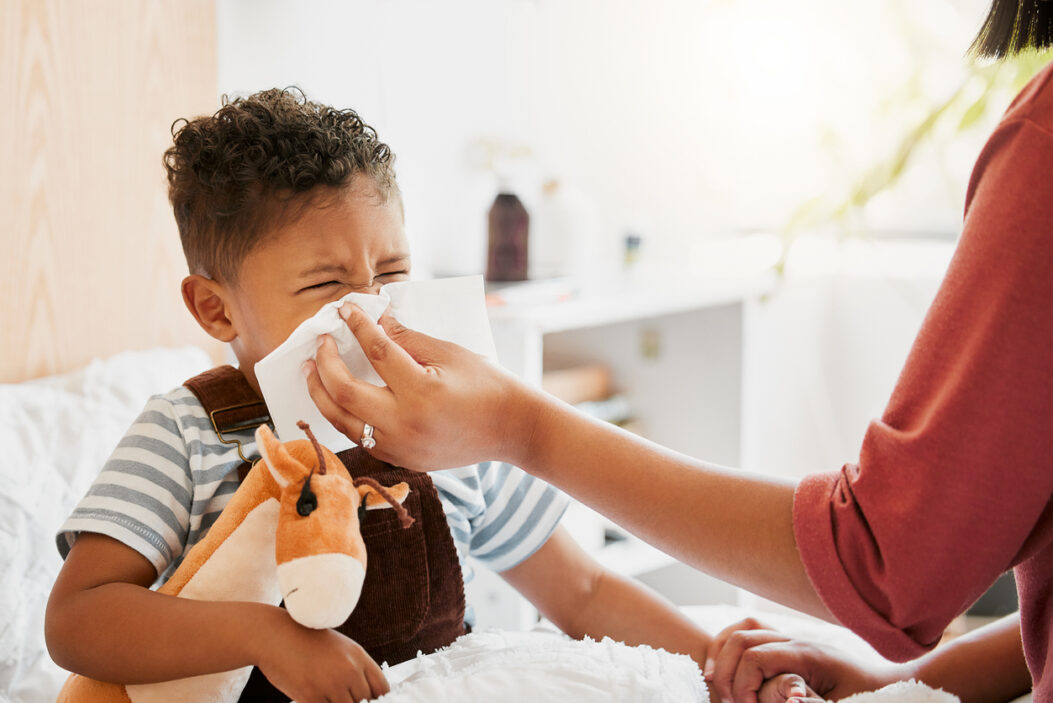
Update: During the week of November 12, 2023, Children’s Health reported a record-breaking amount of RSV cases: 549 cases systemwide—a 339% increase since the week of October 1.
Rarely does RSV and flu season start out on a positive note, but, so far, 2023 promises to take a right turn, thanks to a newly available immunization that protects infants from the Respiratory Syncytial Virus. This is “the most exciting development since the virus was discovered in 1956,” according to Dr. Jeffrey Kahn, Director of Infectious Disease at Children’s Health and Clinical Professor at UT Southwestern.
“We now have two complementary tools: a vaccine pregnant women can get and an antibody that can be given to newborns,” says Kahn. A vaccine is also available for people 60 and older.
For the flu, the various strains that circulate each year make matching the vaccine to the virus a challenge, but early indicators show the shot’s effectiveness for those in the southern hemisphere, who historically experience the virus before it migrates north.
Last year’s respiratory virus explosion could be partially to blame on COVID. During the pandemic, people changed their behaviors (traveled less, washed their hands more, wore masks), which could account for the recent spikes; those who would have potentially had RSV and recovered from it were getting infected for the first time. While most children get RSV by the time they are 2 years old, the virus can cause severe illness such as bronchiolitis (inflammation of the small airways in the lung) and pneumonia (infection of the lungs).
Locally, Children’s Health reported 350 positive cases of RSV during the week of October 9, 2022, approximately 300 cases occurring from October to November 2022, slowly dropping to 250 cases late November, and then tapering down to 130 last December. This year, Children’s reported far fewer numbers—125 positive cases during the week of October 1, 2023.
So when does RSV season officially start? “When children in the ER get tested for RSV and 10 percent test positive, we are in RSV season,” says Dr. Andrew Gelfand, Chief of Pulmonology and Sleep Medicine at Children’s Health and Clinical Professor at UT Southwestern. “Our last numbers (early October 2023) registered 8 percent, so it’s right around the corner and will last about 4 or 5 months.”
RELATED: 5 Natural Ways to Boost Your Child’s Immune System
Does My Child Have RSV or Cold or Flu?
While RSV can present symptoms similar to the common cold—coughing, runny nose, congestion—the virus can quickly escalate in babies. “If an infant is in respiratory distress, you cannot look at that child and determine if it’s the flu or COVID or RSV,” Kahn says. “But if a child has the classical presentation of RSV, and it’s in the middle of RSV season, you’re probably going to be right.”
Kahn and Gelfand caution parents to be less concerned about self-diagnosing their baby and instead watch for respiratory distress, which can cause infants to become dehydrated due to difficulty feeding. Watch for fewer wet diapers, retractions (the chest and ribs go in and out and the nose flares), and even apnea (pauses in breathing) in young infants.
“Babies shouldn’t have to work hard to breathe,” Gelfand says, and parents should seek medical attention for them when they do. RSV can remain an upper respiratory tract infection, “but we worry when it causes swelling in the lower airways and creates the wheezing and labored breathing.”
The flu and COVID can also cause congestion, along with body aches and fever, but “any virus can cause a fever,” says Kahn.
New Immunizations Approved in Time for RSV Season
Recently approved by the FDA, two antibody products, Nirsevimab (Beyfortus) and Palivizumab (Synagis), can help prevent severe RSV disease in infants and young children. Nirsevimab is recommended for infants younger than 8 months of age born during RSV season (or entering their first RSV season) and some children (aged 8–19 months) at increased risk for severe RSV disease and entering their second RSV season.
Palivizumab is limited to use in children younger than 24 months of age with an increased risk for severe RSV disease, such as those with chronic lung disease, patients with cystic fibrosis, or immunocompromised patients. Infants protected from their mothers who received the RSV vaccine do not need to be immunized. As always, ask your trusted healthcare professional for advice.
RELATED: Search our directory of Mom-Approved Health Practitioners
“What makes this not a vaccine is that we are providing the antibody—passive immunity—so your body doesn’t have to make anything, and the antibody lasts for 5 to 6 months, so it’s a safe way to provide patients for the duration of the RSV season,” Kahn says.
Create a Cocoon of Protection
If someone in your household is particularly prone to severe flu, immunocompromised, or perhaps on chemotherapy and may not respond to the flu vaccine, immunize everyone in the household. “Your greatest risk in getting the flu is someone in the household with the flu,” says Kahn, “so if you can eliminate that risk, do so.” Likewise, infants are not eligible for the flu shot until 6 months of age but can still get the flu at 3 months. “If everyone around that infant is protected, then you are protecting that infant.”
Similarly, handwashing and good hygiene is key, and Gelfand recommends, “If you’re sick and someone in the household is high-risk, put a mask on.”
The New RSV Vaccine for Pregnant Women
For pregnant women, the vaccine Abrysvo must be administered between weeks 32 and 36 gestation, and her baby must be full-term to have received the benefits in utero. “This is one of nature’s ways of protecting infants,” says Kahn. “We do this for other diseases and, like most things in life, it’s a matter of timing.”
In clinical trials, the RSVpreF vaccine administered during pregnancy was effective against medically attended severe RSV-associated lower respiratory tract illness in infants, reports the New England Journal of Medicine. The trial included 3,682 maternal participants who received the vaccine and 3676 who received a placebo. Vaccine efficacy was found to be 69.4% at 6 months of age for the infants with no differences in adverse events for those in the study.
This article was originally published in October 2023.
Top image: iStock