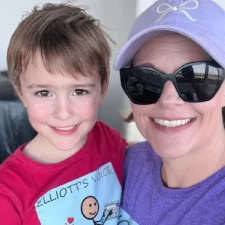
Ten years ago, after her husband’s death, Keller mom Alissa Auer struggled to hold her family together. Her son Chris, now 14, has bipolar disorder, ADHD and Asperger’s Syndrome.
“I’d have to lay with him for over an hour each night because he couldn’t get his mind to quiet down enough to fall asleep,” Auer recalls. “If I was stressed, he’d feel it and not fall asleep, so I had to learn to say, ‘It is what it is’ – that helped me a lot. After my husband died, my counselor wanted me to do things just for me on a regular basis. So I got a massage each month, or I’d go paint at a pottery place.”
Auer received five hours of subsidized respite care a month and also practiced yoga each week while her brother-in-law looked after Chris. Attending Texas Parent to Parent’s conference in Austin each year through a scholarship enabled Auer to meet like-minded parents and find support.
For parents like Auer who have children with special needs, caregiving is often a lifetime commitment. Extreme sleep deprivation is a normal state of being. “Me time” is an utterly foreign concept. And frankly, when you’re on-duty 24/7, preventing parental burnout may seem like a luxury you cannot afford.
Your effectiveness as a caregiver, however, greatly diminishes when you don’t take care of yourself first, says Dr. Sylvia Gearing, a Plano-based clinical psychologist who believes that developing coping mechanisms to deal with ongoing stress and finding ways to recharge your batteries greatly impact your overall health.
“You are you own best defense against stress, and effectiveness in any adversity depends on adequate self-care,” Dr. Gearing explains. “If your body, your mind and your resources are not intact, you’re going to be less effective in the long run. You have to be able to sustain your effort, because it’s so continuous.”
ACCEPTANCE EQUALS RELIEF
For some parents, mental baggage represents a huge source of stress: an overwhelming sense of hopelessness, frustration or guilt over not being able to change their circumstances.
“Parents of children with special needs would give their lives for them. However, there’s a certain amount of natural disappointment that people have to integrate, understand and process – dealing with the fact that this is not the way they thought things would work out for their child, themselves and their family,” Dr. Gearing says. She often counsels patients to engage in radical acceptance, a term from dialectical behavioral therapy that involves moving toward accepting what you cannot change. “The freedom that comes from acceptance means that you suffer less and can be more effective in your caretaking duties.”
Parents understandably find it difficult to shift their perspective while purposely focusing on what they can control, Dr. Gearing notes. “Parents get so tired and pumped up by the adrenaline of the situation; they really think they should have more control over things, and they don’t. They must continually recommit to accepting reality as it is.”
Acceptance helped Auer turn a corner in caring for Chris.
“A lot of what I learned as a young widow really helped me cope: Take care of you, be kind to yourself and get involved in support groups. It’s so good to hear parents talk. You’re not a bad parent if your child needs help,” says Auer, who remarried about four years ago. Cook Children’s Healthcare System has a monthly meeting for parents of children with mental illness that Auer found helpful, and she also attended National Alliance for the Mentally Ill’s support group for parents of adults with mental illness.
GIVE YOURSELF A BREAK
Many parents keep pushing beyond their exhaustion, thinking they cannot afford to take a break. They resort to sleeping in shifts, if at all. And that is another recipe for disaster, Dr. Gearing says.
“Basically, the brain is hijacked when it’s tired. A tired brain is a vulnerable brain, and people who have any kind of stressors need immediate rest,” Dr. Gearing says. Because that is easier said than done, turning to community resources such as organized respite care or asking family members to help out should not be considered a luxury.
Sometimes, Dr. Gearing says, parents need a mental break that only they can provide to themselves. “We ask a lot of our parents to really practice self-soothing skills, allowing their emotional brain to reconnect to their analytical brain, so they can think better in the moment and they’re not so overwhelmed,” she says.
Denton mom Lee Self’s son Joshua, 12, has a range of physical and cognitive challenges including Asperger’s, dysgraphia, ADD, low muscle tone, delayed social skills and executive function issues. To reconnect with each other, Self and her husband Kevin devote each Monday to themselves: They attend a marriage enrichment group, go to dinner and a movie or participate in a support group for parents of kids with special needs. They also buy season tickets to a local theater each year.
Self also spends time with other parents who understand. “Get a group of friends in the same situation and work through the book Building a Joyful Life With Your Child Who Has Special Needs, by Nancy J. Whiteman and Linda Roan-Yager,” she suggests. “Find ways to do little things for yourself regularly too. I get a massage every month, am in a study group and I try to have lunch with one friend a week. Laugh any chance you get, and cry when you need to.”
Dr. Gearing agrees with Self’s strategy, because time spent with a partner is an invaluable way to get support and strength. “Turning to the love of our partners is essential. With all the challenges couples face, when they can bridge together and see themselves as a team working toward a common goal, it makes all the difference in the world,” she says.
A FULL HOUSE
Since adopting their first child 22 years ago, Patti and Deahl Rooks have fostered more than 30 children with special needs and adopted 10. When they could not find a support group in Cleburne, they started their own, Small Blessings Ministry, which offers respite and foster care, monthly support meetings and parent training. Today, the Rooks household includes 12 children ages 5 to 18 who are coping with post-traumatic stress disorder, blindness, deafness, Asperger’s, ADHD, fetal alcohol syndrome, obsessive-compulsive disorder, schizophrenia and missing limbs.
“Parental burn-out is rampant in foster and adoptive care, because of all the mental health issues we deal with,” Patti Brooks says. “We tell parents: Recognize when you need a break, take time for yourself and work closely with your spouse. Build a network of therapists, doctors and others who can help you.”
WHEN TO SEEK HELP
How can you tell when being tired and cranky has morphed into a full-blown burnout that requires immediate attention? One of the signs Dr. Gearing looks for is being regularly and overwhelmingly vulnerable to your emotions.
“I warn parents that when emotions become huge waves that influence and consistently disrupt your day, critical decision-making then becomes emotionally based," she says. "Stress is the precursor to depression and anxiety. With this, the brain can lock down. Literally, fewer parts of the brain react normally. As a result, you’re not making the right decisions or saying the right things, and you’re less effective in your environment and with your child.”
Ultimately, parents should strive to do their best but forgive themselves for not doing the impossible, Dr. Gearing says. “That’s where a therapist might come in and help a parent get that perspective encrypted into their minds,” she says. “This is a marathon, not a sprint, so the sustainability of emotional effectiveness is essential to delivering the kind of care your child needs.”