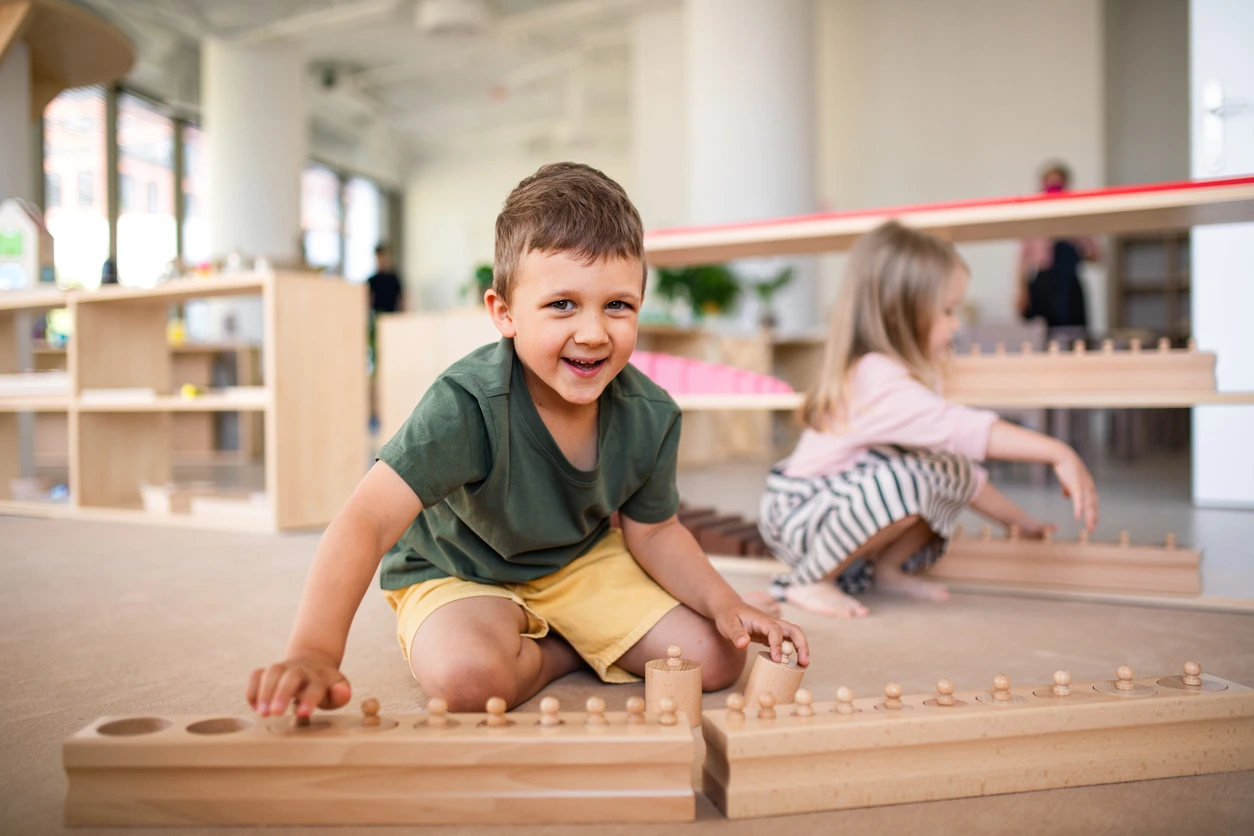
Among the seemingly never-ending choices we make for our little ones, many parents consider choosing an early childhood program and educational philosophy among the most important. After all, we all want to set our kiddos up for success! But with so many options available today, it’s important to understand your choices before making that important decision. One of those options is a Montessori school, which follows an educational philosophy founded on years of scientific observation.
Here’s what you need to know about Montessori schools, the difference between them and regular schools, and what you know to know to determine whether it’s right for your child.
What is the definition of a Montessori school?
A Montessori school follows the child-focused approach to education that was developed by Italian physician, educator and scientist Maria Montessori in the early 1900s. The foundation of this philosophy is that children are naturally curious, learn from their surroundings and crave independence, according to the Montessori Public Policy Initiative. In a Montessori classroom, students follow their own interests while learning at their own pace across a variety of modalities—visual, auditory, tactile, etc.
In addition, all aspects of the Montessori classroom are designed to optimize each child’s cognitive, social, emotional and physical development. This includes furniture, learning materials and supplies.
What is the curriculum?
Just like in traditional classrooms, the curriculum emphasizes academic learning, including reading, writing, math and science. Unlike traditional classrooms, the Montessori school curriculum is student-led with self-paced learning that’s guided, assessed and enriched by teachers, peers and the learning environment. Students learn through discovery using hands-on, interactive and engaging materials and real-life applications.
How much is a Montessori school tuition?
The exact annual tuition depends on which program or school you choose for your child, though it’s not uncommon for tuition to range between $5,000–$20,000 per year. Schools may offer discounts on each additional child, as well as monthly payment plans and even financial assistance for families who qualify. There may also be application, registration and activity fees.
Are Montessori schools religious?
While some private Montessori schools may incorporate religious education in the classroom, the educational philosophy is not religious. In fact, “Students and families from all religious backgrounds are welcome in Montessori schools around the world as diversity is embraced and encouraged,” according to the American Montessori Society (AMS).
What age can kids start Montessori school?
Children as young as infants can be enrolled in Montessori programs. In fact, infant-toddler programs are available in several different formats, according to the Association Montessori Internationale (AMI), consisting of:
• Ante-natal: for expectant parents (yes, even more baby is born!)
• Parent/caregiver and toddlers: so parents can gain an understanding of creating supportive environments for tots
• Nido: (that’s Italian for “nest”) specifically designed for ages 2–14 months who aren’t yet walking
• Infant communities: help ages 14 months to 3 years develop movement, language and independence.
Though often commonly thought of as an early-childhood program, Montessori schools are also available for preschool through high school students. Of course, the exact grade levels vary based on your area. Search Montessori programs in Dallas-Fort Worth here.
Is it a private school?
Some public, magnet, charter or private schools may choose to incorporate the Montessori philosophy school-wide, or even offer it as a school-within-a-school.
Approximately 90% of Montessori schools in the U.S. are private schools, according to the AMS. Though the educational philosophy has been implemented in public, magnet, charter and home-school environments.
What is the difference between a regular school and Montessori?
There are a few differences between mainstream and Montessori classrooms, according to AMI.
In regular classrooms:
• A set curriculum that is the same for every student is followed.
• Teachers lead the students.
• The day is broken up into shorter work periods.
• Children are taught by teachers.
• All students are in the same grade.
And in Montessori classrooms:
• Children learn at their own pace following their own interests.
• Teachers work in collaboration with students.
• Students have longer work periods that allow for deep concentration.
• Children teach themselves using specific hands-on materials.
• Students are different ages, typically spanning 2 to 3 years.
Even with all of these differences, however, the roughly 10% of Montessori schools in the U.S. that are public must meet the same standards as other public schools and comply with other federal education regulations. In fact, students in public Montessori schools are required to take the same standardized tests as students in traditional public schools.
Plus, just like with traditional public schools, teachers in public Montessori classrooms are licensed by the state for the age group they’re teaching and certified by an accredited Montessori teacher education program, according to the AMS.
Want to see what Montessori schools are near you? Search our directory here of Montessori programs in Dallas-Fort Worth.
Top image: iStock