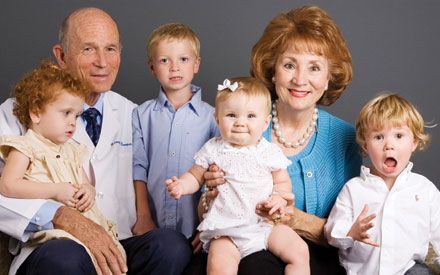
On a recent morning, Dr. Kenneth Cooper prepares for another full day at the office (better known as the stately Cooper Aerobics Center). But today offers a slight change of schedule: Meeting up with his wife, Millie, and four grandkids for a family photo shoot exclusively for NorthTexasChild.
As you can imagine, it sounds much easier than in reality – things quickly (and somewhat comically) turned downhill when Cooper took a wrong turn in the unfamiliar neighborhood and the couple’s 4-year-old granddaughter, Tenley, had a mild bout of car sickness in the backseat. Upon arriving at the studio and saying their hellos, Millie declared with exasperation (and a smile): “The Cooper clan’s here.”
The energy and charisma of the Cooper heirs shined brightly in the studio – Ridge, 5, and sister Tenley, joined cousins and siblings Clark, 3, and 9-month-old Lang (who’s perhaps one of the happiest babies we’ve met). These lucky little ones didn’t miss a beat, flocking strait to the toy basket and plopping down with their picks.
Millie – who the grandbabies call “Mimsey” – quickly changed the kids into their photo attire (with the help of daughter-in-law Angie), touched up her lipstick and exclaimed, “We were married 49 years ago today and I wasn’t even half as nervous as I am now!”
It was understandably nerve-racking to wrangle all four grandkids on set (and work within Cooper’s busy schedule), but once settled, it was easy to notice the love and laughter shared effortlessly between family.
Life as a Granddaddy
Throughout the last thirty years, the father of two – Tyler and Berkley – and the Father of Aerobics, built up his exercise empire in the heart of Dallas. Juggling his research ambitions with the role of a dad was an easy feat for this doctor: Cooper often jogged the grounds of his Aerobics Center alongside his wife and two kids.
Now that the couple’s children are grown and have kids of their own, the situation hasn’t changed a bit. (His son, Dr. Tyler Cooper is working to carry on the Cooper culture by spearheading expansion projects across the Metroplex.) And the onetime empty nesters now frequently welcome the games and giggles that come along with babysitting their four grandbabies.
Being a grandpa has, however, transformed the Dallas doctor’s research interests. Instead of focusing his time and energy on adults, Cooper’s taking aim at America’s youth (and the obesity epidemic) by revolutionizing Texas public schools’ emphasis on healthy eating and exercise.
In the past year, Cooper advocated for the passage of a new Texas state law that requires physical education classes and fitness testing in elementary, middle and high schools across the state. Cooper aims to implement more testing within the next year to further reflect the status of Texan children’s health and fitness.
Tell us about the Cooper grandkids – what kind of fun activities do you enjoy together? Millie and I are very active grandparents and we have lots of opportunities to babysit the grandkids. In fact, just last week we were babysitting Tenley. Millie always jumps at the opportunity to babysit [laughs]. It’s work, but it’s fun. The famous saying about grandkids is that you can play with them and then send them home — true to that. However, we really enjoy our grandkids.
Last weekend we had them all over at the house and I had them out in the pool swimming for about an hour and a half. We had a great time. Lang (9 months) is learning how to swim and Ridge (5 years) is really getting to be a strong swimmer. I like to do lots of active activities with them. But, of course, we frequently go out to dinner and spend a lot of time with them. It’s really a blessing to have our grandkids living in the same community.
Who spoils them more, you or Millie? Oh Millie, without question.
So what are you known for, then? I’m known for paying for dinner [laughs]. No, really, I’m known for doing the more physically active things with them like swimming, taking them for walks … things of that type. I spoil them more with activities. In the winter, I like to ski with the oldest, Ridge, but it won’t be long before the others are old enough to join. It’s just so much fun to be around them.
Did your grandkids serve as a catalyst for the shift in your research from adults to the younger generation? Yes, without question. I say this all the time, but the deplorable situation we have with obesity today means that we’re looking at a dire situation in the future. We know that out of every child born in the year 2000, one out of three Caucasian children will come down with diabetes. And two out of five Hispanics and African Americans will come down with diabetes. If they do that, we know we’ll have 100 million diabetics (compared to 20 million diabetics at the present time) by 2015 when those kids become 15 years of age. Along with that, the life expectancy will be going down from 79 to 72 years over the next 40 years if we don’t do something.
Those are my grandkids. So I would say that, as much as everything else is motivating me to try and change the situation with the lack of fitness and the unbelievable fatness that we have in our state and in our country.
Before Fitness Fame
It wasn’t always fun and games for the Cooper clan (Grandpa and Grandma, at least), whose worldly legacy is that of spreading the importance of preventive health and fitness. It’s taken years of dedication, research, countless late nights, early mornings and a whole lot of faith.
Born in 1931, Cooper quickly discovered a passion for medicine (his own father was a periodontist). Besides medicine, however, the young academic possessed a natural affinity for sports – he was a high school track and basketball star. It didn’t take him long to combine the two interests after graduating from med school and working as the Director of the Aerospace Medical Laboratory in San Antonio (while in the Air Force).
Here, the doctor – who at one time dreamt of becoming an astronaut – developed a series of fitness tests that are still used today by military organizations, athletic teams, law enforcement and even public school systems across the country. While in the Air Force, he penned his first and best-selling book, Aerobics, and started the fitness revolution that struck our nation and the world.
When his term was up at the San Antonio clinic, the growing Cooper family (Millie being pregnant with their first, Tyler) packed their bags and headed to Big D … unknowingly on the cusp of making even more waves in the medical world.
How did your parents influence your academic and athletic pursuits? During my early years, I was raised in an environment where we concentrated on proper food, proper supplementation, but not much interest in exercise. I found that interest on my own, really. I did very well in both track and basketball – wish I knew then what I know now about training. But both my parents were very hardworking and they set an example for me to put extra effort into my interests.
What sparked your interest in aerobics and studying preventative health? I had an interesting experience that occurred when I was 29 years of age. I was overweight and out of shape – I hadn’t done any exercise for practically eight years (while I was in medical school and during my residency).
I was waterskiing up at Lake Texoma, and I tried to ski a slalom course but stopped because my heart was racing in my chest, I was nauseous and I felt like I might pass out. I thought I was having a heart attack. Millie got me to the hospital, but by the time I got there, my heart rate had come back down. The doctor said that the only thing wrong with me was that I was out of shape. Well, I decided to change that, and within six months, I’d lost 40 pounds and in a year’s time I ran my first marathon – the Boston Marathon.
This experience changed my life and it changed my profession. That’s when my interest in exercise physiology began.
Explain your motivation for breaking ground on the Cooper Aerobics Center. Even after my first, second and third book on exercise was published (the last in 1972), in 1984 there still wasn’t an acceptance of exercise in the medical community as one of the keys to prolongation of life. I needed data, which is where the Aerobics Center and the Institute came to shape. At the Institute, data isn’t measured traditionally (by questionnaire); we measured by treadmill time, which blew the naysayers out of the water. The data supporting exercising brought tremendous credibility to our organization.
At what point did you step back and realize that your research revolutionized the world’s perception of aerobics and exercise? When the first book was published in 1968 [Aerobics], the United States had less than 24 percent of the adult population exercising and less than 100,000 joggers. But in 1984, according to the same Gallup polls, we had 59 percent of adults claiming to be exercising and 34 million people jogging regularly. And then by 1990, we had a 48 percent reduction in deaths by heart attacks – all within a 22-year period. That really speaks for itself. 1984 is when I realized that this could really have an impact on the world.
But since the 1990s, we’ve been in a spiraling decline as far as our nation’s fitness and increase in our fatness. Particularly in our nation’s children, which is where I’m focusing my research today.
The Legacy Heard Around the World
How would you define success? Selling more than 30 million books? Or leading a medical revolution? Cooper isn’t focused on claiming fame; he’s just happy to have a loving wife and family who have stuck with him through it all. But this dedicated doctor doesn’t lose sight of what’s to come.
Besides leading legislative changes in Texas to improve our school system’s physical education programs, Cooper and son Tyler recently launched a vast development project in McKinney: The Cooper Aerobics Center at Craig Ranch. The (gorgeous) grounds house the second Aerobics Center, as well as residents subscribing to Cooper Life – a residential lifestyle community promoting healthy living at its finest (with an Aerobics Center membership, personal trainers, nutritionists, boutique doctors and much more).
And what about retirement? At age 77, Cooper says, “No way.” (Though, at the time of the interview he admits he’s been mighty tired from staying up late watching the 2008 Summer Olympic coverage!) But, more seriously, he aims to keep hard at work – about 12 hours a day – maintaining his focus on promoting healthy living in Americans young and old.
When you look to the future, what do you wish most for your grandkids? To live long, healthy lives. And then also for them to keep things in proper priority in their lives, with God at the top. I want my children and grandchildren to be God-fearing children and strong Christians. If they can follow the example of their parents and grandparents in the physical, spiritual and professional aspects of their lives, then I’ll be very pleased.
What do you want the world to view as your legacy? What I’m doing with kids’ fitness in the state and this country. I really feel that the greatest impact that I can have on this country is what we’re doing in Texas, changing the terrible situation of childhood obesity and lack of fitness in our kids. There are about six states and 11 countries now that are looking to implement the same FitnessGram testing that we use here in Texas in their own school systems. So, I really think this work with the younger generation’s health will be my longer-lasting legacy.
What’s the catalyst behind your success? Discipline. You ask my staff – I’m the first person here in the morning and I’m the last to leave at night. I follow my own recommendations to exercise, not smoke and eat a controlled diet, etc. It’s a highly disciplined lifestyle.
But another reason why I think we’ve been so successful is because of these reasons: No. 1 being divine intervention. I’m very strong in my faith and in my beliefs. I start my day with a period of prayer and Bible study. That’s my quiet time in the morning at about 6:30am when I get to the office. No. 2: A fantastic staff. And No. 3: We’ve proven that it’s cheaper and more effective to maintain good health than it is to regain it once it’s lost. But, really, the answer is that we’ve been blessed.