As of June 27, 2023, 34 children in Texas have drowned, and nearly half—15 instances to be exact—happened in pools, according to the Texas Department of Family and Protective Services. In fact, it’s the leading cause of death for children ages 1–4 and the second leading cause of unintentional injury death for children ages 5–14, according to the Centers for Disease Control and Prevention.
These statistics are scary, we know. That’s why it’s imperative that parents—well, everyone, really—know the proper pool safety tips and equipment to help prevent this avoidable tragedy.
Once you read all of these pool safety tips, take the Pool Safety Pledge (available for both adults and children) as a reminder to keep your family safer around the water this summer.
Pool Safety Tips for Parents
Follow these tips to keep your kids safe when swimming in pools, whether that’s in your backyard, at a friend’s pool, your local community pool or one at a hotel on vacation.
1. Make sure your children know how to swim.
The American Academy of Pediatrics (AAP) recommends swimming lessons as a layer of protection against drowning. Children can start as young as 1, however each child develops at a different rate. Not all children are ready to begin at the same age, so take your child’s maturity, physical and developmental limitations and abilities and comfort level in the water into consideration when deciding if it’s time.
It’s also a good idea to take a water safety class to ensure you and your children know how to approach water safety more generally.
2. Supervise children at all times.
When you’re at the pool with toddlers, the AAP says that one of the best safety tips is to use “constant touch supervision,” which means staying within arm’s length of your child. This means getting in the water with your little ones and taking them with you when you need to get out.
When there are multiple children in your group—especially during backyard barbecues or gatherings at the community pool—assign an adult water watcher. This person must pay constant attention to the children in the water and be within reach at all times. At social gatherings, it’s a good idea to have 10- to 15-minute shifts for each water watcher so that no one adult misses out on conversations and socializing.
Download a water water tag from Safe Kids Worldwide, or send an email to safekids@cookchildrens.org to request one. You can also print out a water watcher sign-up sheet.
And yes, this pool safety tip should be enforced even if you’re at the community pool and there is a lifeguard on duty. Lifeguards are not babysitters and cannot keep an eye on every child every minute, especially during the busy summer season.
3. Don’t multitask when kids are in (and near) the pool.
“Two seconds is too long to turn your back on a child in the water,” according to the Fort Worth Drowning Prevention Coalition. This pool safety tip means not distracting yourself by, for instance, reading a book or magazine, talking on the phone, texting or scrolling social media. And don’t leave your kids unattended to go in the house or to the concession stand for snacks and drinks.
4. Teach kids to stay away from pool drains.
Drains and suction outlets have the potential to catch children’s hair, limbs, jewelry or bathing suits if they get too close. Before your kids even get in the water, it’s a good idea to check if the drain cover is loose, broken or missing—if so, avoid the pool until it’s fixed. And if you have a hot tub or spa, locate the emergency vacuum shutoff before going in the water.
5. Have kids wear life jackets that are approved by the U.S. Coast Guard.
Wearing U.S. Coast Guard-approved life jackets can be an important layer of protection for children who lack water safety skills. However, they shouldn’t be used to replace parent supervision or learning to swim, according to the National Drowning Prevention Alliance (NDPA). The NDPA also urges parents to “never replace or substitute arm bands, inner tubes, or other inflatable water toys for tested and approved life jackets.”
6. Put all pool toys away when not in use.
Having toys, balls, floats and water games out in view of children is all the enticement they need to wander over to the pool unattended. The last thing you want is for your child to see a ball floating in the pool near the edge, reach out to grab it, lose their balance and fall in without an adult seeing them. Check out these ideas for pool toy storage from Better Homes & Gardens.
7. Keep all pool chemicals locked up and away from children.
This may seem like a no-brainer, considering we keep cleaning chemicals locked away. But in the excitement of taking a dip in the backyard pool, it can be easy to forget to put away any chemicals you’ve just used. If you keep your chlorine in the same shed as your kids’ pool toys, store them on a shelf that kids cannot reach or lock them in a cabinet. It’s also a good idea to have the number for Poison Control handy, just in case. Program 1-800-222-1222 into your phone.
8. Learn and get certified in CPR.
If something goes wrong, this pool safety tip can be the difference between life and death while waiting for emergency personnel to arrive. According to the American Heart Association, “70 percent of Americans may feel helpless to act during a cardiac emergency because they either do not know how to administer CPR or their training has significantly lapsed.”
Given that startling statistic, it’s a good idea to brush up on your CPR skills by taking a certification course. You can find one near you through the Red Cross, American Heart Association (in-person or virtual) or through your local YMCA.
And it’s not just adults who can learn and administer CPR. According to a May 2023 statement from the AHA, the European Resuscitation Council and the International Liaison Committee on Resuscitation, children as young as 4 can begin building the skills, so that by around age 10, they can perform effective chest compressions.
9. Teach your kids about pool safety.
It’s never too early to teach your kids the importance of water and pool safety. PoolSafely.gov has some great resources created for kids to help them learn. They can take the Pool Safely pledge with Olympian Michael Phelps, sing the “Pool Safely” song with kindie superstar Laurie Berkner and play on the free interactive, educational app The Adventures of Splish and Splash (available for Apple and Google Play).
Pool Safety Equipment
Community pools should have this equipment on hand to keep swimmers safe and in case of emergency. It’s also a good idea to have this equipment for your own backyard pool to limit the risk of drowning.
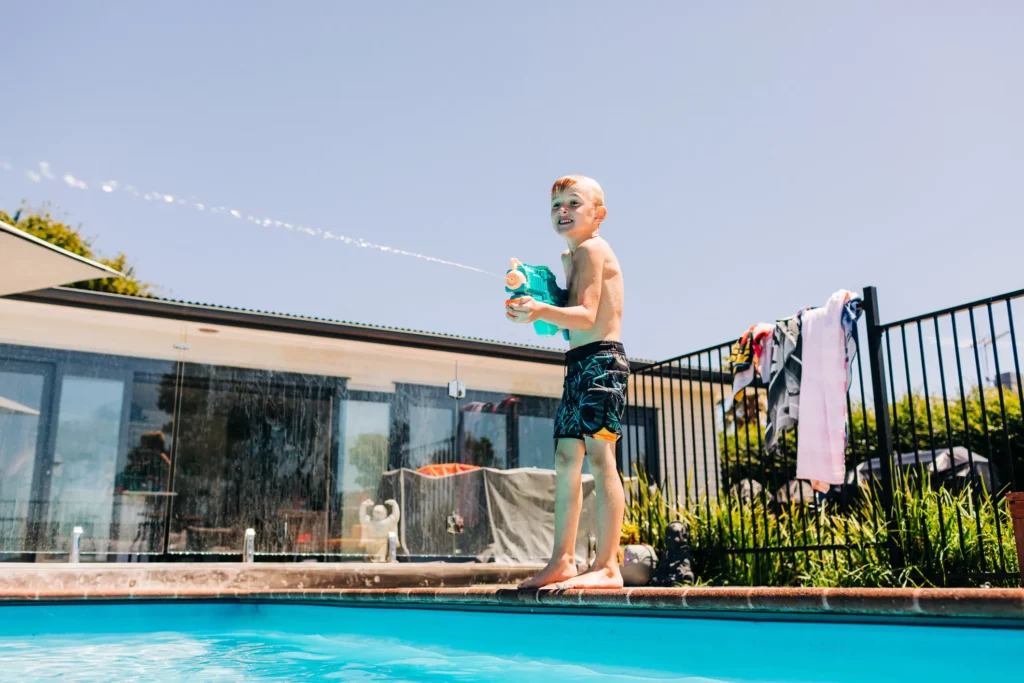
1. Surround your pool with a fence to prevent access without an adult.
Though some states do have laws on the books requiring pool safety fences, Texas does not. Still the American Academy of Pediatrics says, “Fences are the most effective, proven way to prevent drowning of young children.”
That’s why the organization advises that backyard pools (inground and above ground) and hot tubs be completely surrounded by a fence that is at least 4 feet high, is not climbable, has proper slat spacing (no more than 4 inches if it’s a fence with vertical slats), has a self-latching, self-closing gate.
The latch should also be out of reach of little ones to prevent them from opening the gate on their own. Looking for a good place to start? D&D Technologies offers gates with audible and visual alarms. The company also has a great checklist for pool safety fences and gates you can download and go through at the beginning of each pool season.
2. Install sturdy covers on pools and hot tubs.
NDPA recommends pool and hot tub owners choose safety covers that meet the ASTM International voluntary standard F1346-91, which has four requirements:
- The pool cover must be able to hold at least 485 pounds. It’s considered the combined weight of two average adults and one child.
- The cover must pass a Perimeter Deflection Test in which manufacturers have to prove that any openings on the cover are too small to allow objects to pass through, and that they are strong enough to withstand any efforts to pass through.
- The cover must pass a Surface Drainage Test, proving that the cover is designed so that excess water does not collect on the surface.
- The pool cover must be properly labeled, so consumers can clearly understand information such as manufacturer warranties and ASTM standard warnings.
3. Check pools and spas for compliant drain covers.
Yes, even the drains pose a danger. The Virginia Graeme Baker Pool & Spa Safety Act was named after 7-year-old Virginia, who drowned after she was trapped underwater by the powerful suction from a hot tub drain. Ensuring your pool and/or hot tub has a drain grate or cover that meets safety standards is an important step in pool safety.
4. Be prepared for a water emergency.
The last thing anyone wants is a water emergency at the pool, but it could happen. So the best thing to do is to be prepared by enrolling in a water safety class to learn proper rescue techniques. Look for a course that includes hands-on practice using rescue equipment. And make sure your pool has reaching and throwing devices for quick rescue, posted CPR instructions and a breathing mask as well as a well-stocked, first-aid kit.
The Red Cross also advises doing the following to safely help someone who is in trouble in the water:
- Alert the lifeguard, if one is present.
- Recognize the signs of someone in trouble and shout for help. A swimmer needs immediate help if they are not making forward progress in the water, are vertical in the water but unable to move or tread water or are motionless and face down in the water.
- Rescue and remove the person from the water (without putting yourself in danger).
- Ask someone to call emergency medical services. If alone, give 2 minutes of care, then call 911.
- Begin rescue breathing and CPR.
- Use an AED (automated external defibrillator), if available, and transfer care to advanced life
RELATED: Where to Take Swimming Lessons in Dallas-Fort Worth
Images: iStock