As a Texas parent, it’s important to know your rights and the laws when it comes to all things education, health and welfare for your child. Like every other state in the union, Texas has its own host of laws on the books that affect your children and you as a parent. Some might enhance your parental rights, while others, if not obeyed, could land you in jail or create other civil or criminal liabilities.
For example, your best friend makes every kid who rides in her car sit in a booster seat, even though some of them are almost 10 years old; you just make sure they’re buckled into their seats. She says it’s the law. Who’s right? (Scroll to #16.)
But how do you know what’s the law and what’s rumor? To help clear up some of the biggest misconceptions, take a look through our quick guide of nearly 30 Texas laws that are most relevant to parents of young children.
Education
1. HOW LONG CAN I KEEP MY KIDS HOME WITH ME BEFORE I HAVE TO SEND THEM TO SCHOOL?
In Texas, children who are at least 6 years old and under 19 are required to attend school, but kindergarten is not mandatory. The minimum age for free education is 5 years old while the maximum age is 21, according to the 2020 National Center for Education Statistics. However, if the kid is enrolled in school, they are subject to compulsory school attendance rules. Read more details at the Texas Education Agency Early Childhood Education FAQs sheet.
RELATED: How to Choose the Right School for Your Child
2. MY SON IS BEING BULLIED AT SCHOOL? WHAT CAN WE DO?
First, it is important to understand whether the acts are defined as bullying according to Texas law. This checklist, which is also available in Spanish, is an easy tool to see if the act fits the criteria.
The Texas Educational Code gives the parents of a bullied child the right to request the transfer of their child to another classroom or another campus within the school district. If the board of trustees verifies the bullying, there is no time limit placed on the transfer. (And note that it’s not required for the school district to provide transportation to the new school.)
For a complete rundown of your bullying laws and resources, visit Texas School Safety Center. Note that principals can make a report to any school district police department after an investigation is complete; a court can issue a temporary restraining order, temporary injunction or permanent injunction.
3. CAN WE HOMESCHOOL OUR KIDS?
Yes. Texas has permitted homeschooling since the Texas Supreme Court’s ruling in Leeper v. Arlington ISD (1999). In Leeper, the court decided that home schools are the equivalent of private schools under the Texas Education Code, thus exempting school-aged, home-schooled children from the state’s compulsory school attendance laws. Texas is considered one of the most homeschool-friendly states because the law doesn’t require parents who homeschool their children to register themselves, test their children, get approval for their materials or even count attendance.
Additionally, parents who homeschool are not required to have teaching certificates or college degrees in order to homeschool their children. There are only three laws to follow, according to Texas Home School Coalition Association: “the instruction must be bona fide, the curriculum must be in visual form and the curriculum must include the five basic subjects of reading, spelling, grammar, mathematics and good citizenship.”
RELATED: How to Identify Your Child’s Learning Style
4. I WANT MY TWINS TO BE IN THE SAME CLASS. DO I HAVE A RIGHT TO DEMAND THAT?
Texas is one of a handful of states in the country to give parents the right to determine the placement of their multiple-birth children. Under EDUC 25.043, parents have the legal right to keep their multiples together in school. The law gives parents 14 days after the enrollment of their multiples to inform school officials in writing whether they want them in the same class. The law also allows the school principal to challenge the placement if it’s deemed disruptive, but parents also have the right to appeal the principal’s challenge.
RELATED: Where to Find Mom Groups in Dallas-Fort Worth
5. I WANT TO SEE MY CHILD’S SCHOOL RECORD. CAN I?
Yes. Under the Texas Education Code, parents are entitled to see all written records a school district keeps on their children: attendance records, test scores, grades, disciplinary action, counseling, psychological testing, behavior reports, teacher and counselor evaluations, and more.
6. I THINK IT WOULD BE IN MY CHILD’S BEST INTEREST TO BE HELD BACK A YEAR. WHAT ARE MY RIGHTS IN ASKING FOR THIS?
Per House Bill 3803, which reinstates provisions made for COVID-19, parents have the right to make this decision for their child in first through eighth grade. (Previously, parents could only make this decision for their child through third grade). Check out the Texas Education Agency’s recommendations for what to consider when making this decision and the proper steps to take.
RELATED: Should You Hold Your Child Back a Grade?
Health & Safety
7. IN TEXAS, WHO IS ALLOWED TO MAKE LIFE-OR-DEALTH DECISIONS FOR EXTREMELY PREMATURE BABIES: PARENTS OR HOSPITAL STAFF?
While recognizing that parents ordinarily have the right to consent to or decline medical care for their children, the Supreme Court of Texas ruled in Miller v. HCA, Inc. (2003) that an exception arises when doctors must administer treatment immediately to prevent the death of the child, such as in the case of a premature child, writes John Robertson, University of Texas law professor and bioethicist.
8. MY KID IS ALWAYS BRUISED FROM PLAYING. HIS TEACHER SUSPECTED WE WERE ABUSING HIM AND CALLED THE POLICE ON US. WHY’D SHE DO THAT? WE’RE GOOD PARENTS!
She was following Texas law, which requires any professional who believes that a child is being abused, neglected or exploited to report suspicions to the Department of Family and Protective Services within 48 hours. The law provides the person making the report with immunity, as long as she acted in good faith. If your son’s teacher hadn’t reported her suspicions, she could have been charged with a crime.
RELATED: Domestic Violence Resources in Dallas-Fort Worth
9. IS TEXAS AMONG ONE OF THE FEW STATES TO CLARIFY THAT PARENTS, NOT SCHOOL DISTRICTS, WILL HAVE THE FINAL SAY ON WHETHER THEIR CHILDREN TAKE DRUGS (SUCH AS RITALIN) TO CONTROL BEHAVIOR?
Yes, Texas Education Code (Section 38.016) states that it is illegal for school personnel to recommend that a student use a psychotropic drug (such as Ritalin) or to suggest any particular diagnosis, according to David Anderson, general counsel for the Texas Education Agency. If parents refuse to give their child a psychotropic drug (even after a psychiatric evaluation), the child cannot be kept from attending class or participating in a school-related activity. However, the law does not prohibit a school district employee from recommending that a child be evaluated by an appropriate medical practitioner, notes Anderson.
10. I’M NOT SURE I WANT MY KIDS VACCINATED AGAINST ALL OF THE DISEASES THAT THE PEDIATRICIAN RECOMMENDS. DO I HAVE A CHOICE?
Texas law (administrative code 97.63) requires children attending daycare, school and college to be vaccinated against a variety of childhood diseases, ranging from Hepatitis B to chicken pox to polio.
But the state also permits parents to exempt their children from these vaccinations based on reasons of conscience, including religious beliefs or medical conditions. To obtain the exemption, contact the Texas Department of Health.
11. MY HUSBAND HUNTS, SO WE HAVE GUNS IN OUR HOUSE. WHAT SHOULD WE DO WITH THEM?
Keep them locked up and out of reach of the kids, says Alice Tripp, former legislative director of the Texas State Rifle Association in Addison. Texas law makes it a class C misdemeanor, punishable by a fine up to $500, if a child under the age of 17 can easily access a gun when an adult knows it’s accessible.
If the child fires the gun and injures someone, the gun owner could be sent to jail. Courts will look to see if you’ve tried to keep the gun away from little ones when deciding punishment, Tripp says, so keeping the gun in a locked cabinet or using a trigger lock may curry favor with a judge. These gun laws, however, do not bar children from hunting or engaging in any other shooting sports with training and appropriate adult supervision, Tripp adds.
12. OUR DOG GROWLS AT OUR NEIGHBORS’ TODDLERS. WHAT HAPPENS IF HE BITES A CHILD?
Under Lillian’s Law (2007)—named after Lillian Stiles, a 76-year-old woman who was attacked and killed by dogs that had escaped from their yard—owners of dangerous dogs can be charged with a third-degree felony if they fail to secure their dog, and their dog leaves their property, makes an unprovoked attack and seriously injures a person.
If the unprovoked attack results in death, the owner of the dog can be charged with a second-degree felony, punishable by up to 20 years in prison. But a dog does not necessarily have to actually bite a person to be declared dangerous; if a person feels threatened by a dog, they can petition local authorities to declare it dangerous. For more general information, Kenneth M. Phillips breaks down Texas’ dog bite laws.
13. HOW OLD DO MY KIDS NEED TO BE BEFORE THEY CAN BE LEFT HOME ALONE BY THEMSELVES?
Unfortunately here, the answer is unclear, as Texas law provides no specific recommendations, however, Texas Department of Family and Protective Services recommends considering several factors before leaving a child home alone, including the age; emotional maturity and capability of the child; the layout and safety of the home or play area; the child’s ability to respond to an emergency; and whether the child has any mental, physical or medical disabilities.
14. MY CHILD’S FRIENDS ALL HAVE SOCIAL MEDIA ACCOUNTS AND NOW MY KID FEELS LEFT OUT AND DESPERATELY WANTS THEIR OWN. WHAT PROTECTIONS ARE IN PLACE FOR MINORS ONLINE?
The Securing Children Online Through Parental Empowerment (SCOPE) Act, which went into effect Sept. 1, 2024, requires apps, websites and software to protect minors from harmful content and data collection practices. Under the SCOPE Act, harmful content includes anything that promotes, glorifies or facilitates self-harm, eating disorders, substance abuse, bullying, sexual exploitation and abuse. Plus, digital service providers must supply parents with tools that allow them to limit and supervise their child’s use of the service.
RELATED: Apps That Help Control Screen Time
15. DO MY KIDS REALLY HAVE TO WEAR BIKE HELMETS?
While wearing a helmet could save you or your children from head trauma, there is no statewide law for any age must wear a helmet—but local law is a different story. To be sure, check with your local city hall for suburban bike helmet laws. In Dallas, for example, city law mandates bike helmets for anyone under 18 riding a bike.
Car Safety
16. MY FRIEND INSISTS HER OLDER KIDS SIT IN BOOSTER SEATS IN THE CAR. IS THAT A LAW?
Maybe. According to the Texas Department of Transportation, children younger than 8 (unless they’re taller than 4 feet 9 inches) are required to be secured in a child safety seat, like a booster seat with the adult lap and shoulder belt, until the adult safety belt fits them properly, which could be anywhere from 8 to 12 years old.
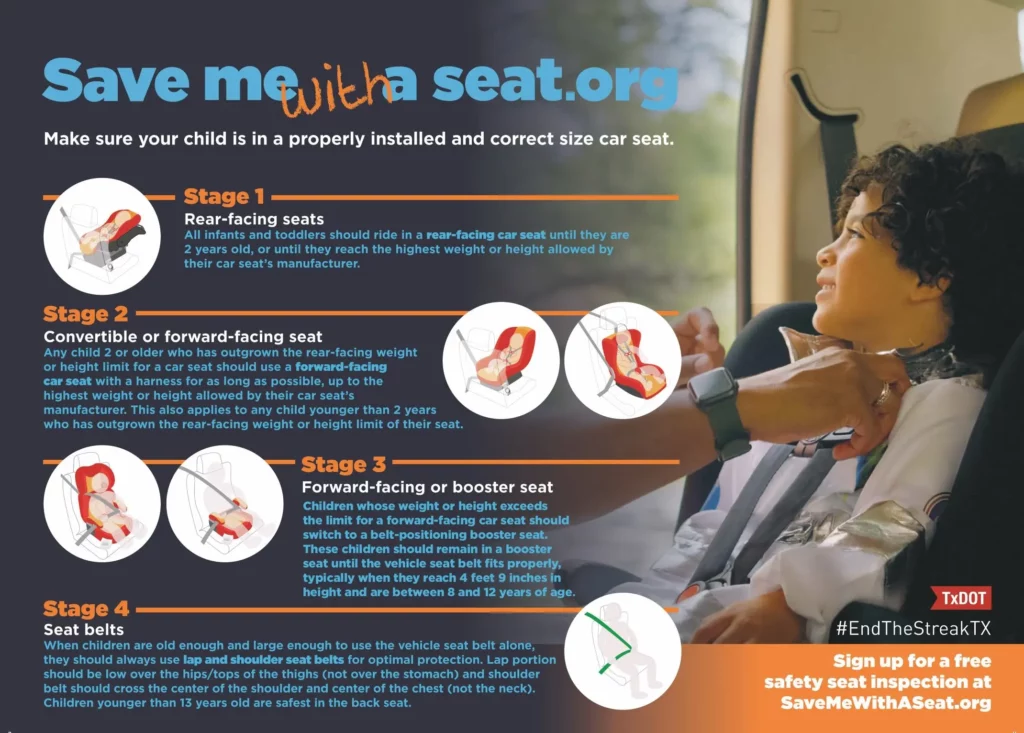
17. MY 2-YEAR-OLD HAS ALREADY FIGURED OUT HOW TO UNDO THE LATCH ON HER CAR SEAT. DO I REALLY NEED TO MAKE SURE SHE’S IN A CAR SEAT?
Yes! Texas law mandates that children under 8 must be restrained in a child safety seat while in a car, according to the Texas Department of Transportation. Be sure to check the seat’s label on height and weight information, and check out this guide for helpful information on when each seat type is best.
18. WHAT ABOUT SEAT BELTS?
Click it, or ticket. Texas law requires all passengers and the driver in a vehicle to buckle up, according to the Texas Department of Transportation. If you’re caught driving with unbelted minors, a ticket will set you back up to $250.
19. MY WIFE OFTEN LEAVES OUR BABY SLEEPING IN THE CAR WHILE SHE RUNS INTO THE DRY CLEANERS. IS THAT OK?
Absolutely not. This is “neglectful supervision,” according to Texas Department of Family and Protective Services, and under Texas law, a parent can be charged with a class C misdemeanor for intentionally leaving any child 7 years or younger unattended or left with a child under 14 in a car for more than five minutes. If the child is injured as a result of being left in the car, the crime can be increased to a felony, punishable by up to two years in jail and a fine of up to $10,000.
20. MY EX WAS JUST ARRESTED FOR DRIVING UNDER THE INFLUENCE. TO MAKE MATTERS WORSE, OUR KIDS WERE IN THE CAR WHEN HE WAS PULLED OVER. IS IT TRUE HE CAN GO TO JAIL?
Quite possibly, says Dallas lawyer Paula Larsen, a former family court judge. Under the law, individuals who drive impaired with kids younger than 15 in the car will be charged with child endangerment, a felony in Texas. That comes with a fine of up to $10,000 and up to two years of jail time—on top of what they are charged with for their DUI offense.
Welfare
21. IF I DON’T HAVE A WILL, WHAT WILL HAPPEN TO MY ASSETS – WILL THEY AUTOMATICALLY GO TO MY KIDS?
If a parent dies without a will and there’s a surviving spouse, generally the surviving husband/wife will inherit all community property, plus one-third of the personal estate. The rest of the personal estate is equally divided among the children of the deceased parent.
In the event that both parents die and there’s no will, the probate court will appoint a guardian for the minor child, looking first at any surviving grandparent, followed by aunts and uncles, or any other qualified relative or interested person with the overarching requirement that the appointment be in the child’s best interest, says Wendy D. Dawer, Of Counsel at Jones, Davis & Jackson, PC in Dallas. “Dying without a valid will is not the legal nightmare situation you might imagine,” says Dawer.
22. WHAT IF MY CHILDREN ARE VERY YOUNG, WHAT HAPPENS TO THE ESTATE THEY INHERIT? WHO TAKES CONTROL OF IT?
When a minor inherits (whether from a parent, grandparent or other), the funds are placed into a trust account until the minor reaches an age of maturity, says Dawer. “If the inheritance is without a will, someone who wants to be appointed guardian applies to the court to act as trustee. It can either be the same person applying to be appointed guardian or someone else, even a bank in some circumstances. This commonly happens where natural parents have divorced and one parent dies, leaving an inheritance to the child,” explains Dawer.
In the case of insurance policies, investment accounts, etc., the designated beneficiary is entitled to the funds regardless of whether there’s a will in place.
23. WE CREATED OUR WILL IN ANOTHER STATE. DOES IT STILL APPLY IN TEXAS?
Wills prepared in other states might not comply with Texas’ probate requirements, advises Dawer. The best advice is to have a new will prepared upon a change of state residency.
24. MY EX ISN’T PAYING CHILD SUPPORT. CAN I REFUSE TO ALLOW HER TO SEE OUR KIDS UNTIL SHE PAYS UP?
No, says Larsen. Child support is an independent obligation. Violating one obligation does not justify the violation of the other and could get you in trouble with the law for withholding visitation.
25. HOW CAN I MAKE SURE MY EX PAYS CHILD SUPPORT?
In Texas, a parent can be jailed for failing to pay child support. “People get sent to jail every day for non-payment of child support,” cautions Larsen. A criminal contempt charge can be filed in the civil courts, not the criminal courts. She adds, “The criminal aspect is that a parent found to be in contempt can be jailed for up to six months on each count of contempt (or each missed payment). The civil or coercive aspect is that the parent can remain jailed until the entire past due amount is paid in full.”
Parents have another way to help get their former spouses to pay child support, says Dallas family lawyer Diana Friedman. Under the law, non-payment of child support obligations can result in the suspension or loss of your state licenses. “If you don’t pay child support, all of your licenses—driver’s, hunting, even professional licenses—can be taken away,” she says.
Texas law also allows judges to require parents to take out a life insurance policy to ensure child support in the event of death, adds Friedman.
26. I LOST MY JOB AND CAN’T AFFORD THE CHILD SUPPORT PAYMENTS THAT I AM SUPPOSED TO MAKE. WHAT ARE MY OPTIONS?
You must go to court to get your obligations changed, says Friedman. Even if your ex agrees to less, a judge must officially amend the reduction or you could be held in contempt of court with the possibility of jail.
27. I CAN’T AFFORD HEALTH INSURANCE FOR MY KIDS. CAN I MAKE MY EX PAY FOR IT?
Yes, says Larsen. Texas law allows courts to order the noncustodial parent to maintain health insurance for the children, as long as it’s a “reasonable cost” of the parent’s net resources—9% for health and 1.5% for dental.
If the parent cannot obtain reasonably priced health insurance, Larsen says judges can order additional medical support payments. If a parent fails to follow a court order to maintain health insurance for his or her children, a judge can order payment of past-due support with interest, fine you or sentence you to jail, suspend your driver’s license, hunting and fishing licenses and any professional licenses, and more.
28. I WANT TO MOVE OUT OF DALLAS, BUT MY EX IS FIGHTING ME. CAN THE COURT REALLY MAKE ME STAY HERE?
In a nutshell, yes, says Friedman. Dallas County courts are renowned for their strong domicile restrictions on children of divorced parents and will not lift them unless both parents agree. The upshot, says Friedman, is that it’s nearly impossible to get a court to lift the restriction if one parent objects.
29. MY IN-LAWS HAVE TRIED TO TURN OUR CHILDREN AGAINST US. CAN WE KEEP THEM AWAY FROM OUR KIDS?
You can. In 2000, the U.S. Supreme Court severely limited the circumstances under which a grandparent can sue for visitation or custody, says Larsen, and Texas law has been changed to reflect the Supreme Court decision in Troxel v. Granville (2000). Now grandparents can only prevail in a custody or visitation suit to see their grandchildren if they can prove that the parents are unfit or that denying the grandparents’ access to their grandchild would significantly impair the grandchild’s health or well-being. “The Supreme Court essentially said there is a presumption that a fit parent knows what is best for his or her child,” Larsen explains.
RELATED: Search DFWChild’s directories of schools, camps & healthcare providers
Top image: iStock
This article was originally published November 2008.