


Spring is in bloom, and along with warmer temperatures and more daylight, fields of flowers—including tulips or the state’s pride, bluebonnets—are one of the season’s gifts. Whether you’re looking for a family photo op or want to teach your kids about how flowers grow, you don’t have to go far to find spectacular displays.
Our state is known for its wildflowers—roughly 5,000 species of them—so for some springtime flower tourism with your family, we’ve mapped out a few of our favorite flower festivals and garden destinations in North and Central Texas. Here you’ll walk among multicolored bluebonnets at their peak, a highly sought-after flower we’ve borrowed from the Dutch, and many more fresh blooms you may have never noticed.
Dallas Arboretum and Botanical Garden
Where: 8525 Garland Road, Dallas
What you’ll see: Dubbed one of “The Best Places to See Stunning Spring Blooms Across the South,” by Southern Living, the Dallas Arboretum is nothing short of show-stopping. The picture-perfect Dallas Blooms display features over 500,000 blossoms, wine and beer pairings, live music, children’s activities and more. Expect over 100 varieties of spring bulbs, thousands of azaleas and hundreds of Japanese cherry trees as your family explores the grounds.
Even after Dallas Blooms exhibit wraps up in mid-April, there’s still plenty of horticultural beauty on the garden grounds. Over the course of the year, you’ll enjoy seasonal and perennial flowers and plants, Japanese maples, a lily pond, spacious lawns and much more. The Rory Meyers Children’s Adventure Garden offers a variety of life and earth sciences programs and other family-friendly activities.
Admission: Admission varies slightly by the season, and for the rest of spring is $16 for adults; $10 for children; under 2 free.
RELATED: A Guide to the Dallas Arboretum
Bluebonnet Trails
Where: 201 NW Main Street, Ennis
What you’ll see: For the widest of wide open spaces, start here at the official Bluebonnet City of Texas, about 30 miles south of Dallas. Ennis welcomes the public to explore 40 miles of trails that point you directly to the fields with the lushest flower growth. To navigate them, download the interactive Ennis Y’all mobile app, or pick up a printed map at the Ennis Welcome Center on Main Street.
The downtown district will be hopping with a full-blown festival of live music and kids’ activities the weekend of April 19–21, so visit then to make the most of your trip. Better still, follow up your bluebonnet frolicking with retro outdoor movie screening at Galaxy Drive-in.
Admission: There is no charge to drive the trails. The festival is $5 for adults; children 12 and under are free. Learn more at bluebonnettrail.org.
Fort Worth Botanic Garden
Where: 3220 Botanic Garden Blvd., Fort Worth
What you’ll see: Plan a two-stop adventure with your family at botanic garden and the Botanical Research Institute of Texas (BRIT). A wonderland for plant lovers, the BRIT features a wide array of wildflowers (including bluebonnets) throughout the campus. As the oldest garden of its kind in Texas, Fort Worth Botanic Garden covers 111 acres, with 22 gardens displaying regional fauna and flora. Visitors can also view some nonlocal beauties, such as more than 1,600 species of begonia and orchids.
Many more flowering trees, shrubs and vines well worth admiring grow here. This season, take a stroll through the Fuller and Horseshoe Gardens and by the Garden Club Council building to find blossoms such as the bright yellow Japanese kerria, Crossvine, and Oakleaf hydrangeas. If you really like hydrangeas, you’ll love the Chinese snowball, which are expected to bloom this April.
If you can, come for the Spring Japanese Festival on April 20–21. No visit to the botanic garden is complete without stopping into the Japanese Garden and feeding the koi fish.
Admission: $12 for adults; $6 for children; under 6 free. Peak pricing on-site: $15 adults; $9 children.
RELATED: A Guide to Fort Worth Botanic Garden
Native Texas Park at George W. Bush Presidential Center
Where: 2943 SMU Boulevard, Dallas
What you’ll see: This 15-acre urban nature park, located behind the presidential center on the Southern Methodist University campus, recreates several native Texas environments with native grasses and a wildflower meadow full of bluebonnets along a one-mile network of walking trails.
Bring the kids during daylight hours, any day year-round, for a self-guided scavenger hunt and to learn about the flora and fauna, or join the guided tours on Saturday mornings at 10am March 23–June 1. The garden tours are free, but you’ll definitely want to head inside the Bush Center, too, to see the Freedom Matters exhibition of rare, historical documents.
Admission: Free admission to the nature park. Museum admission is $26 for adults, $24 for teens 13–17, $20 children 5–12; under 5 free. Learn more at bushcenter.org.
Restoring Roadsides
Ever wonder why or how the highway roadsides in Texas get to be covered in colorful wildflowers each spring? For that we credit Texas Department of Transportation, which first began planting wildflowers along the roads in 1932, and Lady Bird Johnson (1912–2007).
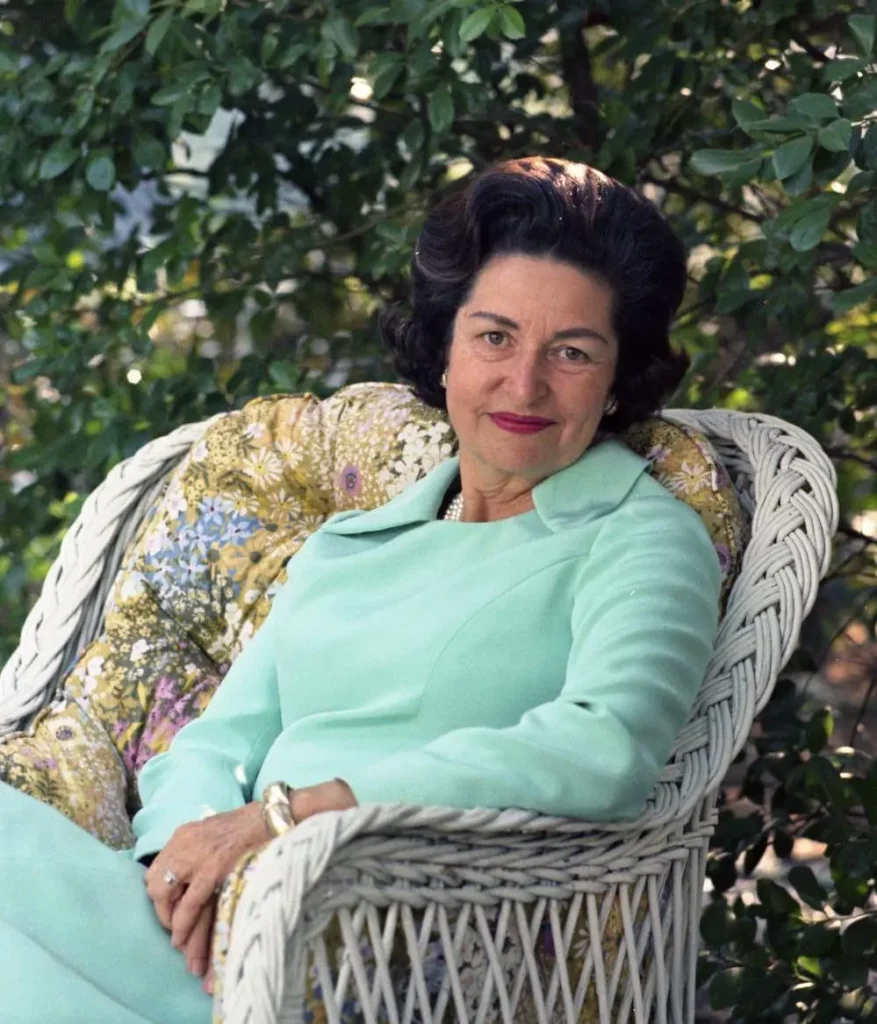
Former first lady Claudia Alta Taylor “Lady Bird” Johnson, shown above in 1968, earned the nickname as a child and is best remembered today for championing environmental causes. During her time as first lady, she lead the effort for Congress to pass the Highway Beautification Act of 1965, which encouraged wildflower planting and healthy landscapes with native plants, and limited billboards and junkyards alongside the federal highway system. Today you can visit her namesake wildflower center in Austin.
The Gardens at Texas A&M University
Where: 556 John Kimbrough Boulevard, College Station
What you’ll see: If you’re heading farther south, it’s worth the drive at least once to marvel the university’s signature maroon bluebonnets developed by two horticulturists back in the ‘80s. You can see the maroonbonnets—also called crimson bonnets or Alamo Fire—as well as pink and white varieties and traditional bluebonnets blooming through early to-mid April at the Gardens at Texas A&M, located behind AgriLife Center.
For no charge, visitors can walk the 27-acre garden, open daily from dawn to dusk. For extra kid-friendly fun, come visit on Saturday, April 20, during the free Hullabloom Fest, a morning of spring-inspired crafts and demonstrations. Your kids will learn all about pollinators and even help release live butterflies into the open air.
Admission: Free. Learn more at gardens.tamu.edu.
Arbor Hills Nature Preserve
Where: 6701 W. Parker Road, Plano
What you’ll see: Within Plano city limits, Arbor Hills Nature Preserve is a natural respite left largely undisturbed. With three distinct ecoregions, the preserve is worth a visit this spring. The Blackland Prairie offers abundant wildflowers: bluebonnets, Indian blanket, winecup, horsemint and many types of yellow daisies. The flowering vines often attract bees, butterflies and hummingbirds. We recommend trekking to the observation tower for a bird’s-eye view of the park.
Admission: Free. Learn more at plano.gov.
Cedar Hill State Park
Where: 1570 West FM 1382, Cedar Hill
What you’ll see: Two ecosystems intersect to provide a unique array of plants across this park’s 1,200 acres. The landscape includes brown-eyed Susan, American basket-flower, Barbara’s buttons and bluebonnets. For a perfect nature walk, we suggest stopping at the Penn Farm Agricultural History Center and the rolling hills near the park’s entrance on North Spine Road.
Admission: $7 for adults (day use); children under 12 are free. Learn more at tpwd.texas.gov.
Fort Worth Nature Center & Refuge
Where: 9601 Fossil Ridge Road, Fort Worth
What you’ll see: The center provides more than 20 miles of hikes over 3,621 acres, making it one of the largest city-owned nature centers in the country. It’s home to many wildflowers native to Texas, like white rosinweed, Engelmann’s sage and milkweed, among others. Hiking trails range in difficulty, so there’s a trail for everyone. Do note that taking photos or walking in the wildflower patches is not permitted, but selfies on the trail are OK.
Admission: $6 for adults; $2 for children ages 3–12; children under 3 are free. Learn more at fwnaturecenter.org.
Coppell Nature Park
Where: 367 Freeport Parkway, Coppell
What you’ll see: Located within Wagon Wheel Park in west Coppell, the 66-acre park offers a natural habitat for an array of wildlife and flora. Throughout spring months, spot Texas Indian paintbrushes, bluebonnets, partridge peas, nodding thistles, firewheels and much more along the hiking trails. Make a stop at the Biodiversity Education Center and butterfly garden to round out your visit.
Admission: Free. Learn more at coppellnaturepark.org.
Heard Natural Science Museum & Wildlife Sanctuary
Where: 1 Nature Place, McKinney
What you’ll see: The natural wonders at the Heard are endless, and they include bright blooms throughout the sanctuary. You’ll view Indian paintbrush, milkweeds, Texas Dutchman’s pipe and more wildflowers. Be sure to stop by the Native Texas Butterfly House & Garden when it opens in early June. And for an unusual spring flower, travel down to the Wood Duck Trail and find the Green Dragon along the stream beds.
Admission: $12 for adults, $9 for children age 3 and up; children 2 and under are free. Learn more at heardmuseum.org.
The Rose Gardens of Farmers Branch
Where: Start at Gussie Field Watterworth Park, 2610 Valley View Lane, Farmers Branch; or the Farmers Branch Historical Park, 2540 Farmers Branch Lane
What you’ll see: While these roses gardens are not technically wild flowers, they sure are beautiful and well worth the visit to take in the beauty at four large gardens, with more than 1,500 rose bushes. The butterfly garden and a bird sanctuary are perfect stops along the trail too.
Admission: Free admission. Learn more at farmersbranchtx.gov.
Where are your favorite spots to see wildflowers? Let us know at editorial@dfwchild.com.
Image: iStock


