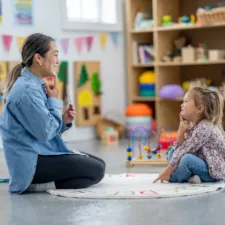
A haven of rural calm that’s hidden from plain sight along Central Expressway, the sleepy town of Fairview (that’s soon to burst at its retail seams) is home to one of the Metroplex’s most unique – yet unsung – schools: The Robert Muller Center for Living Ethics. Its young students (kindergarten through grade 6) thrive on fresh country air and a one-of-a-kind story-based curriculum that has come together under the inspired direction of the school’s founder, Vicki Johnston.
A conversation with Johnston leaves you feeling as calm and clear as the peaceful knolls and knots of trees that surround the school. We visited with Johnston about how she weaves together stories and plays that connect with children simultaneously as knowledge and as wisdom – as she puts it, “a synthesis of the various sciences told in terms of the mutually sustaining relationship between the whole and its parts.”
Tell us a little bit about how the Robert Muller School for Living Ethics came to be. Having graduated from The University of Texas at El Paso and earning a Texas teaching certificate, I continued my education, earning teaching certificates from the American Montessori Society (AMS) and a master’s in education focusing on Montessori methods at Texas Wesleyan in Fort Worth.
The ideals and methodology of the Montessori approach served as a starting point for my quest to develop an approach to learning that brings children joy. Here at the Robert Muller Center for Living Ethics, I’ve worked to interweave several approaches to learning, including aspects of village environments and the storytelling approach of indigenous peoples.
What does your school offer young children that they can’t find in other schools? The signature approach of the Robert Muller Center for Living Ethics is the Harmonies Way Teaching StoryArt Series. … I firmly believe that it’s possible to meld knowledge, art and ethics together by using stories as a main artery of teaching/learning. For the past 15 years, I have written a teaching story series for children ranging from ages 3-12.
While those for the youngest children focus on nature and the seasons, the series for the elementary children includes more advanced topics, such as the history of ideas (or the history of humanity), American history (with inclusion of the American Indian point of view), astronomy, meteorology and geology, the cultural series (including eight world cultures), and the companion to these, the biomes of the world series. The stories are written to engage children with a sense of connectedness to all life and to portray the virtues universally valued by humanity.
With the growing interest in homeschooling, green and natural living and other alternatives for families and children, have you seen an upswing in interest and awareness of the concepts and ideas you use at the school? Yes, recently we have noticed an upswing in homeschooling families reaching out to participate in the Robert Muller Center for Living Ethics learning community. We wholeheartedly welcome this inclusion. The teaching stories offer the opportunity for collaboration between home and the activities of the center.
How are parents involved at the Robert Muller school? An especially enjoyable aspect of the village method of teaching is providing children a network of mentors. Invariably there are certain kids who are drawn to the special talents and skills of adult mentors here at the school (many of whom are students’ parents). It’s easy to see how mentors enhance and extend the possibilities for each student’s individualized learning and development.
Is there an aspect of your work that you find especially challenging? Yearly, I visit with parents whose children suffer from academic environments that put too much pressure on students with formal, competitive, over-structured, test-driven systems that prevent exploration, creativity and innovation.
What is the single most important thing the parent of a child in a traditional, academically-focused elementary school can do to further their children’s learning and development? I would say to them, See your child for the special being she/he is. Academic measurements are not the measure of your child or his/her future success. (Studies have proven this.) She/he is not a collection of lessons, test scores and sports scores. She/he is not here to make you look successful as a parent. In proportion to your trust in his/her natural impulse toward growth and expansion, in proportion to your encouragement (instead of judgment), and in response to your delight in him/her uniqueness, she/he will reveal a shining soul with an individual purpose. Through joyful immersion in childhood, your child is attaining the full stature of adulthood.
More Info: The Robert Muller Center for Living Ethics, www.centerforlivingethics.org