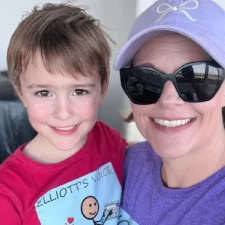
Angela and Michael O’Brien’s neighborhood, Lewisville’s Castle Hills subdivision, has seven children under the age of 8 with Down syndrome. She belongs to a local Down syndrome guild and finds her life rather like that of most parents with two small children.
Five years ago, when her daughter, Casey, was born with Down syndrome, her viewpoint was a quite different.
“It’s a pretty rough message to hear at first, because I really didn’t know anyone with Down syndrome before,” O’Brien says. “I didn’t grow up with anyone with disabilities in our school. It’s the fear of the unknown. Quite honestly, if I knew what our life would be like now when she was born, I would’ve said what am I crying about?”
O’Brien talks about the loss of the dream, which many parents of children with Down syndrome discuss. With it often comes the story by Emily Perl Kingsley, “Welcome to Holland.” Kingley, who was a writer on Sesame Street, is author of Count Us In: Growing Up with Down Syndrome. “Welcome to Holland” is an article that compares giving birth to a special needs child to arriving in an unexpected country. You’re packed and ready for Italy, then suddenly land in Holland: “The important thing is that they haven’t taken you to a horrible, disgusting, filthy place, full of pestilence, famine and disease. It’s just a different place,” she writes.
Theresa Moffitt had a similar transition when her daughter Candace, now 8, was born.
“You have hopes and dreams for that child whether or not you’ve verbalized them,” says Moffitt, president of the Down Syndrome Partnership of Tarrant County. “For a typical child, you think there is that possibility that they can be whatever they want to be. When you find out your child has Down syndrome, all of those things come crashing to a halt. When we were still in the hospital I was already wondering what’s going to happen to her when I’m 60.”
Like O’Brien, Moffitt’s point of view changed as she got to know her child and learned more about Down syndrome. On a broader scale, that same understanding is happening — although much more slowly — in society.
Four decades ago, many special needs children were institutionalized. Attitudes started changing in 1968, when Eunice Kennedy Shriver founded the Special Olympics. Suddenly, people with special needs didn’t need to be hidden.
While much progress has been made, people who aren’t familiar with special-needs children often don’t know what to say, think or do when around a child with Down syndrome. O’Brien explains the syndrome to us just as she explains it to her 6-year-old son: “Basically, Down syndrome means you just need help learning.”
Education
In 1975, the U.S. Congressed passed its first law regarding the education of special needs children — the Education of All Handicapped Children Act — giving children who qualify the right to a “free and appropriate public education,” or FAPE (now called the Individuals with Disabilities Act, IDEA). In 1981, Texas legislators formed the Early Childhood Intervention program, although services to all eligible children didn’t begin until 1993. In 1996, preschool children (ages 3 to 5) were added to the IDEA.
Just as school is one key facet of the childhood experience for typical children, so it is for children with Down syndrome.
Early Childhood Intervention
Deion Marks of Richardson is a single mother of four. Her youngest, Shemiah, just turned 1.
At her weekly home visit, Alice Oglesby, an early intervention specialist at The Warren Center in Richardson, notes that Shemiah’s ankles look weak, a sign of low muscle tone common in children with Down syndrome. She suggests Marks get her high-sided shoes. She watches as Shemiah cruises down the couch in search of toys, transitioning to the coffee table — all on target with typical 1-year-olds.
Oglesby spends 45 minutes to an hour with Shemiah, always leaving homework for Marks. This week, she shows her how to use a rolled-up towel to support Shemiah under her arms. Marks is to work with her, holding onto the towel behind her and walking with her.
“We’re just the coaches,” Oglesby says. “We’re not there to do it for them.”
Having these visits in the home is key: “That’s how a child learns best,” says Amy Spawn, early childhood intervention (ECI) program director at The Warren Center. “If they’re learning to climb stairs, then learning to climb our stairs doesn’t help.”
Marks sees Shemiah developing and is patient with it: “She’s doing a lot for her age,” she says. “We’re just taking it one step at a time and letting Shemiah be Shemiah.”
Before the federal government mandated ECI for special needs students (which came after Texas mandated it) a group of parents got together and formed The Warren Center, which started its own version of early childhood intervention 40 years ago.
Kids with Down syndrome have a tremendous head start. Down syndrome is diagnosed almost immediately, compared to, say autism, which often isn’t diagnosed for years. So early intervention can start almost immediately. And, with state-mandated early intervention programs, it usually does.
What does ECI do? Helps you get on with your trip to Holland.
“The tulips in Holland are gorgeous,” says Kay Hopper, executive director of The Warren Center. “They only bloom for two weeks, so we’re going to make sure you don’t miss the tulips. We’re going to make sure that you see those special events that you might miss because you didn’t know you were looking for them.”
Dallas County has six ECI programs, Denton County has two, and Tarrant County has one. Services are provided on a sliding-scale fee, based on family size and income, ranging from $10 to $150 a month for one-on-one weekly therapy in your home — speech therapy, occupational therapy, whatever your child needs. The Warren Center, which covers Richardson ISD and a small part of Dallas ISD, currently has 260 clients, 12 of whom have Down syndrome.
These specialists and parents are starting within weeks of a child’s birth, but they are looking years down the road.
“Because of the early intervention, our kids just have so much better opportunities to do things,” Moffitt says. “A lot of kids with Down syndrome are going to college these days. They’re getting married and living in an apartment on their own, independently. Now that doesn’t mean somebody doesn’t look in on them and help them with finances. But they’re going to the grocery store. That’s what I want for Candace, to have that independence. I think her future is as bright as my other daughter. And I don’t think those expectations were there 20 years ago.”
Inclusion
Kelly Drablos, president of the Down Syndrome Guild of Dallas became an advocate for inclusion when her daughter, Alana, now 24, was a baby.
“I became an advocate for inclusion when she was tiny,” Drablos says. “I wanted her to be fully involved with typical children. The idea of mainstreaming is sort of a ’60s idea. Before IDEA, some school districts didn’t provide any education.”
Inclusion — both at the higher and lower end of the cognitive spectrum — came about in the ’80s, when educators realized “kids needed to live, work, play, learn together,” Drablos explains. When she first enrolled Alana at Lovejoy Elementary in the fourth grade, it was somewhat of a crazy idea. And a first for the school. Alana went on to graduate from Allen High School in 2004, lives in Fairview with her mom and dad, and is a clerk at Kroger.
“The vast majority of people with Down syndrome can learn to read,” she says. “They have a range of abilities just like the general population. Alana reads very well. She reads the newspaper. But lots of people with Down syndrome who are 45 years old and older don’t read at all. People in their 30s are reading, and people in their 20s are reading, writing, typing, e-mailing, Facebooking.”
Inclusion is a word many people throw around. Here’s how Peggy Dyer, director of The Rise School, defines it: “Inclusion is not just sitting the child in the classroom. It’s making him belong.”
John and Wendy Poston began The Rise School in 1998, three years after the birth of their twins, one of whom has Down syndrome. The school, replicated from the original Rise Program in Alabama, serves children between the ages of 18 months and 6. Two-thirds of the school’s students are special needs (generally Down syndrome), while one-third are typical learning children.
While the lessons are geared at typical children, the school is filled with help for its students with Down syndrome — little chairs have foam attached to the back for support of children with low muscle tone and a room full of foam steps, beach balls, tricycles, and a trampoline designed to work those often-lacking gross-motor skills.
The Rise School models inclusion by its student body makeup and prepares its students with Down syndrome to be ready for inclusion elsewhere.
“The Rise model prepares kids to work in a classroom,” says Dr. Steven Kernie, the parent of a son with Down syndrome and a researcher in the field. “They can stay on task, know how to stay in line, follow directions. They learn and learn how to learn. There’s not a lot of coddling those kids. You need to learn how to function in the real world even when you’re a little kid. Those lessons are extremely valuable. Sometimes kids tend to be overprotected. They don’t get out in the real world much,” he says.
When Kernie’s son John (pictured with his father above) left The Rise School, he began kindergarten at Armstrong Elementary in Highland Park ISD. Kernie takes the state’s “least restrictive environment” mandate seriously. And thinks it’s the best way for John to learn.
“The worst thing that can happen is that you have a full-time aid,” he says. “That’s something public schools really advertise, that if you need, we can get you a full-time aid. We don’t want an aid. We don’t even want a part-time aid. Then the kids get used to it and it becomes a dependency issue. They’re not forced to learn real life skills.”
However, Kernie acknowledges that this model of care doesn’t work for every child, and that some children often require and benefit from more assistance. John currently spends two-thirds of his time in the traditional classroom and one-third in what’s called life skills. Sometimes he gets one-on-one tutoring; other times he works in a group.
In Denton ISD, as in every other Texas ISD, every special needs child that is eligible for services gets his or her own committee — the admission review and dismissal committee. The first committee meeting is before the child starts school, annually after that. The committee includes the child’s parents, an administrator from the school campus (usually a principal or assistant principal), specialists if the child has specific special needs (such as a hearing, visual, or speech impairment, a psychologist, ESL teacher or translator), a special education teacher, general education teacher and an assessment professional.
Denton ISD serves just under 2,400 special needs children, a little more than 10 percent of its student population. While each school district’s program is slightly different, each must provide instruction for any special needs child over the age of 3 in some form. Sometimes that means going to the child’s neighborhood school. Sometimes there will be a designated school in the district for the district’s preschool programs for children with disabilities.
“It’s only fair we keep the kids in the least restrictive environment,” says Val Morgan, director of Denton ISD’s special education department. “It is part of the law, but it’s also the right thing to do.”
Moffitt agrees. Candace (pictured above left at school) is a second-grader at Kooken Education Center in Arlington ISD. Her classmates have started to notice that she’s a little different, a little slower to catch onto things. They are protective, accepting and careful of her, Moffitt says.“I’m very much for inclusion and want my child to be included,” Moffitt says. “Candace is very outgoing, personable, wants to be around people. She’s not going to be happy doing data entry or putting widgets in boxes. Now, taking your order at McDonald’s, that’s something she’d be interested in.”
Research
Medically, not much has changed about having Down syndrome in the past two decades. It was about that long ago that the congenital heart disease that as many as half of children with Down syndrome were born with became a fairly easy fix.
What has changed is that now parents and physicians aren’t dealing with as many medical issues — especially after the toddler years — both are spending more time dealing with cognitive issues.
Stanford School of Medicine’s Down Syndrome Research Center is at the forefront of research into Down syndrome, a relatively under-researched syndrome. Why? It’s complicated and under-funded — not a good combination. As one of only a few such research centers in the nation, its hypothesis is that “cognitive dysfunction is in part due to abnormalities in the structure and function of the synapses.”
Kernie, who did his undergraduate work at Stanford, explains.
As an associate professor of pediatrics and developmental biology at UT Southwestern Medical Center and a pediatric critical care specialist at Children’s Medical Center, Kernie spends his research time studying brain development and brain injury. Like the researchers at Stanford, Kernie’s specific field of research focuses on the part of the brain called the hippocampus, which is the section of the brain most affected in children with Down syndrome.
The hippocampus is one of the few areas of the brain that has stem cells. In the hippocampus, the stem cells become neurons that form synapses with other neurons. If researchers can determine what makes these stem cells become neurons, they may be able to replenish these neurons with adult stem cells and improve cognitive ability.
When a brain is injured — say, in a car accident or after a stroke — the brain does a lot of repair all by itself, even though it may never fully recover to its previous function.
“What we’re trying to figure out is what the molecules are that mediate that repair,” Kernie says. “With Down syndrome, the ability to do that is impaired. The idea [of this research] is helping that process along.”
The hippocampus becomes smaller and atrophies as Alzheimer’s disease progresses. One of the few genes to be implicated in Alzheimer’s is chromosome 21.
The researchers at Stanford also spend a lot of time studying chromosome 21 genes. While all people with Down syndrome are different — just as are all typically functioning people — one thing they have in common is a duplication of all genes on their 21st chromosome.
The Connection to Alzheimer’s Disease
Kernie and others interested in promoting research into Down syndrome have found a path to funding and interest in Alzheimer’s. While there isn’t much money given to Down syndrome research, plenty is given to research into Alzheimer’s disease.
Two facts tie the two together:
1. Every person with Down syndrome eventually will develop Alzheimer’s.
2. Chromosome 21 is a key piece of both puzzles.
“There are lots of people interested in studying Alzheimer’s disease,” Kernie says. “Nobody knows if they’re going to get it. Everybody has a relative that’s had it. What I have been doing is making that link. If we study this population, where you have a population you know are all going to get this disease, it makes a lot of sense to study them at a very young age. Scientists, like everybody else, gravitate where the funding is.”
Is this a lot of pressure on a man who has dedicated his career to studying the very part of the brain that makes his son different?
“Yes and no,” he says. “He is just one of our kids. He’s just going to need love and support. I don’t let it preoccupy me. I enjoy him so much now, and I know I always will. If there are things that can make his life and our lives better, I’m going to push for that. But I don’t feel a lot of pressure about it. Part of that may be because he’s still a little kid. That may change when he’s a teenager or in his 20s.
“There’s a lot of work on a lot of different fronts, and my front is such a tiny little piece of it. I try to keep a bigger picture in mind as far as what I think can be done in Dallas and nationally and what I’d like to see happen. I’ve got a 7-year-old who I know is going to get Alzheimer’s disease, and I’m most likely going to live long enough to see it happening. But I’ve got decades, which is a long time-frame to work in.”
Resources
Joanna Spahis has been the clinical nurse specialist with the Down Syndrome Clinic at Children’s Medical Center of Dallas since it opened in 1993. Children with Down syndrome from birth to age 18 generally visit the clinic annually, or every two years once they get older, for one-stop expert advice from the center’s pediatricians, clinical nurse specialists, genetic counselors, speech therapist, physical therapist, social worker, and parent representative from the Down Syndrome Guild of Dallas.
“They see all these people in probably half a day,” Spahis says. “It’s a great opportunity to get information and advice from specialists about medical care, financial information, social programs, therapy issues, a variety of topics.”
Spahis sees the progress research, education and parents are making in Down syndrome just by watching the children who come into the clinic.
“We have kids coming to us in better shape because their primary doctors are more educated because we have a clinic in town,” she says. “Another thing, I think, is the attitude and educational advancements. Many more of them are being included in regular classrooms. I think they are better prepared when they go to school, and they are more accepted in the mainstream.”
Which is exactly the progress parents like O’Brien hope to keep making.
“We need to redefine the possibilities for these children,” O’Brien says. “We don’t know what their potential is anymore because it’s beyond where we once thought. We need to set our expectations higher. Our goal is to have kids with Down syndrome valued in our community. It’s getting better and better. I had no clue before she was born. It’s been quite an education for me. And I’m the better person for it.”
Holland, she finds, isn’t as scary as she thought it would be.