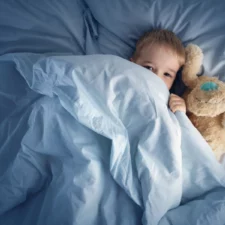
My son Kieper used to snore. Loudly. He also woke up tired every morning and sported dark circles under his eyes that made him look more like an 80-year-old than a first grader. In fact, we called him the “cranky old man” in the morning because of his moody manner.
He was getting 10-11 hours of shut-eye each night. But, his teacher started sending home notes that Kieper appeared sleepy or out of sorts during the school day.
After consulting an ear, nose and throat specialist (otolaryngologist), we discovered Kieper was suffering from obstructive sleep apnea (OSA)—a disorder that can strike anyone from young to old. And, turns out his enlarged tonsils were to blame.
Most parents associate tonsil problems with pesky sore throats. Thirty years ago (back when many of us were in elementary school), 90 percent of tonsillectomies in children were performed to remedy recurrent throat infections, according to the American Academy of Otolaryngology – Head and Neck Surgery (AAO – HNS).
Now, however, it’s more common for children to have their tonsils removed due to sleep-disordered breathing (SDB), which includes snoring and OSA, than recurrent sore throats, says Kenneth H. Lee, MD, PhD, assistant professor of Otolaryngology Head & Neck Surgery at UT Southwestern Medical Center.
More than half a million kids undergo tonsillectomies each year in the US—80 percent of those driven by sleep issues.
So how do you know if your child suffers from sleep apnea? Lee says the “gold standard” for diagnosing OSA is a full-night polysomnography or sleep study. But, the test can be expensive, time consuming and often requires a long wait—a wait that some kids who are underperforming in school can’t afford.
Most otolaryngologists will opt instead to consider clinical evidence and, the obvious, a parent’s keen observations in a child who comes in with chronic swollen tonsils and adenoids, reports Lee.
In Kieper’s case, his doctor (who was not Lee) asked me to watch Kieper sleep: Was he taking long pauses in breathing, as well as snorting or gasping? Quickly I discovered what his brothers (who he shares a room with) already knew and had come to accept (or ignore): yes, he was.
“A history of observing a child sleep with pausing for 5-10 seconds followed by gasping is highly correlated and indicative of at least mild sleep apnea or sleep disordered breathing,” says Lee.
And, the research is telling. Kids who suffer from OSA are more likely to have trouble with behavior, school performance and bed-wetting, reports the AAO – HNS.
With Kieper, it also took a swipe at his confidence; sufferers don’t know why they are so tired and lack concentration during the day since they sleep through breathing episodes at night.
Surgery is first line of treatment for pediatric sleep disordered breathing, reports the AAO – HNS. Lee says that nine times out of 10 in cases of SDB or OSA symptoms resolve completely once the tonsils and adenoids are removed.
The risk of catching strep throat also decreases significantly—or, the bouts will be less severe than previously, adds Lee.
For Kieper, the difference was dramatic. Once he navigated the long recovery (roughly 10 days of rest), the dark circles (and dark cloud) disappeared. He woke up easier, had more energy during the day and showed marked improvements in concentration and memory.
But do children still have their tonsils removed to curtail old-fashioned sore throats? Lee says yes, but new standards published by the AAO – HNS in January give doctors and parents a set of more stringent criteria.
In the past, three episodes of swollen or infected tonsils in a year might dictate a tonsillectomy. The new guidelines, however, require at least seven well-documented episodes of throat infection (such as tonsillitis or strep throat) in a year, or at least five occurrences each year for two years or three bouts annually.
As for Kieper, he put the “cranky old man” to rest … at least for another 60 years or so.
This article was originally published in May 2011.