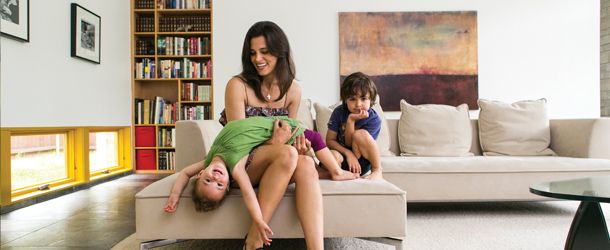
Clea Verven’s family-friendly East Dallas home showcases the vision and talents of her husband, award-winning architect Steven Janeway. He saw potential in an irregular-shaped, half-acre lot nestled in the bohemian community of Little Forest Hills, home to nearly a thousand small wood-frame cottages and bungalows dating to the 1920s, ’30s and ’40s. “It took nearly two years to build the house, during which time I was pregnant with our first child [Kenneth, now 4],” says Clea, a former high school art teacher. “This house was Steven’s baby!”
“I immediately saw the possibility in the unusual shape of the lot, which is really a truncated triangle,” Steven says. “Using the extra dimensions of the backyard to create a secure place for the kids to play became the focus of much of the design.”
The family now includes daughter Helen, who turned 2 in mid-May. Her father arranged the interior of the single-story, 3,600-square-foot home so the massive living room would look out onto the patio and verdant backyard. “As a family, we spend most of our time in the living room, which has 10-foot slider glass windows and a huge view,” Clea says. “It’s so open and comfortable that we naturally gravitate here.”
Adds Steven: “I design high-rises in my professional life, so I knew I wanted a lot of daylight in the house.” To amplify the illumination and capture the breezes in spring and fall, Steven also added low windows along the floor.
“The house is very sustainable – I’m energy-conscious and resource-conscious,” he says. Case in point: For both the exterior and select interior elements, Steven used scrap Lueders limestone, quarried in Texas and left over from the 35-story Omni Fort Worth Hotel that Steven designed.
The couple chose other eco-minded materials that would withstand the rigors of family life, including slate flooring warmed by a radiant-heating system. In the kids’ rooms, they used bamboo flooring, which “warms the room and dampens sound,” Steven says. The cabinetry throughout the home is sustainable European beech, prized for its long, clean grain.
Among the best-loved features of the home is the corridor adjacent to Kenneth and Helen’s bedrooms, which share a Jack-and-Jill bathroom. Steven designed a wall of windows with different dimensions and heights as a nod to the childhood experience. “As the kids grow up and change, their view of the world will change,” he says. “The windows were a way to express that idea.”
In the master bedroom as well as the living room, the couple inlaid pieces of carpet flush to the floor. “When I was expecting Kenneth, Steven would come and ask me for my opinion on carpet samples and paint colors, but I wasn’t too concerned about giving input. I was really comfortable leaving the choices up to him.”
Together, the couple selected most of the home’s contemporary furnishings, much of which they found at Ligne Roset in the Dallas Design District as well as Crate & Barrel. From his bachelor days, Steven had a Noguchi coffee table, which is about the only piece in the house the duo treats as precious. (“We don’t have it out much anymore,” Clea admits.) Instead, the durable surfaces, forgiving materials and superior flow of the residence mean that the children use every room, from the music room housing the piano and guitars to the kitchen, which looks out onto the garden.
Kenneth even learned to ride his bike around the interior of the house.
“It’s a great home for kids,” Clea says. “Perfect for play dates.”